



|
Quantity
|
Total
|
||
|
|
|||
|
|
|||
Maneki-neko, Japanese lucky cat
Maneki-neko is a Japanese cat with a raised paw that stands at the threshold of a home or business, inviting money, people and good fortune inside. To European eyes, its gesture may resemble a farewell, but in Japan, a palm facing forward with fingers curling inward clearly means "come here." The world responds to such a call when it knows who is being welcomed: place the figurine where you receive guests, work or keep money.
This Japanese lucky cat is also called a money cat. In its name, "maneki" means "to beckon" and "neko" means "cat." Choose a maneki-neko according to the invitation you want to leave in your space: for people, prosperity or favourable changes.
Where the Japanese lucky cat came from
The history of maneki-neko begins in Edo-period Japan, between the 17th and 19th centuries, and follows several paths at once. The best-known leads to Tokyo's Gotoku-ji Temple: the head priest's cat raised its paw to beckon a noble samurai, said to have been a lord of the Ii clan. During a storm, he took shelter at the temple and later became its patron. Today, thousands of white figurines are brought here by people wishing to give thanks for a fulfilled intention.
Another path leads from Imado, where hardship once came to an old woman in a dream through the voice of her cat. In the dream, the animal asked her to mould its image from clay, and the woman began selling the figurines near a shrine. This is how the money cat helped her escape poverty. In one version, the courtesan Usugumo appears alongside this image: her cat remained a symbol of protection and good fortune.
At first, maneki-neko remained a temple souvenir, a sign of gratitude for a heard request. Later, the figurine appeared in trading shops, where its gesture was clear to everyone: the cat at the entrance invited a person to cross the threshold. The image later reached Chinese merchants, and golden cats with mechanically waving paws and attributes of Chinese tradition appeared.
How the beckoning gesture works
The raised paw of a maneki-neko is directed toward those you want to see nearby. In the Japanese gesture, the palm faces outward and the fingers beckon closer, so the figurine suits an entrance, cash register, reception desk or any place where visitors, orders and money appear.
Intention gives this gesture a clear destination, while the cat keeps it before your eyes. Name silently what you are waiting for: new clients, payment for your work, money for education or a steady flow of orders. The cosmos, like a person at the door, finds it easier to respond to a clear invitation, while a figurine without such meaning remains simply a decoration.
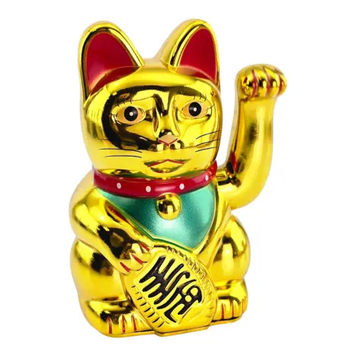
Models with a moving paw repeat the invitation without pause and help you maintain the rhythm you have set. Suitable options include a 10 cm solar-powered golden cat, a 17 cm solar-powered cat and cats with waving paws from 11 to 20.5 cm tall. Movement will not do the work for you, but it will remind you every day of what you are directing your attention toward.
What the right and left paws of maneki-neko mean
The right paw carries the promise of prosperity: place such a cat at home, by your workspace or near financial records when money needs to find its way into the home and remain there. The left paw invites people: clients, guests, friends and useful connections. Let the figurine's gesture match what you are expecting now, rather than its colour or size.
|
Paw |
What it invites |
Where it is usually placed |
|
Right |
Money, luck, material prosperity |
At home, near the workspace, beside financial records |
|
Left |
Clients, guests, useful connections |
In a shop, office, at reception, near the entrance |
|
Both paws |
Protection and an invitation for everything at once |
In the shared space of a home or business |
Two raised paws resemble wide-open doors: such a cat invites opportunities while protecting the space. Some practitioners call it "greedy" because it reaches out to many things at once. When you have one clear goal, let a figurine with one raised paw serve it, so its meaning remains focused.
A high-raised paw sends the invitation further, like a sign visible from the other end of the street. It is often placed where a flow of people from outside matters. In different sources, the meanings of the right and left paws are sometimes reversed, so a left paw is usually chosen for a shop and a right paw for a home, following temple tradition and personal intention.
What the colour of maneki-neko means
The colour of a maneki-neko clarifies what you are making room for at home, in an office or in personal practice. The paw sets the movement of the flow, while the shade helps define it more precisely.
|
Colour |
Sphere |
Traditional or modern interpretation |
|
White |
Happiness, purity of intention |
Classic |
|
Gold |
Wealth, prosperity |
Traditional interpretation |
|
Black |
Protection from evil and the evil eye |
Traditional interpretation |
|
Red |
Health, protection from illness |
Traditional interpretation |
|
Pink |
Love, relationships |
Modern interpretation |
|
Green |
Health, education |
Modern interpretation |
|
Blue |
Calm, wisdom |
Modern interpretation |
|
Purple and orange |
Personal growth, the atmosphere of a space |
Modern interpretations |
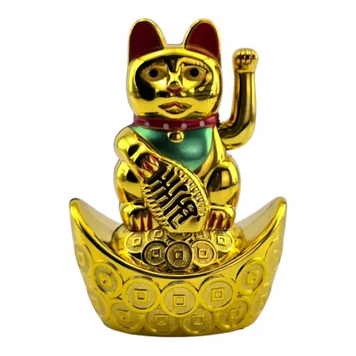
A tricolour cat with white, black and ginger patches remains the classic image. Its colouring is associated with Japanese bobtails and combines luck, protection and vitality. A golden cat on a wealth bowl is worth placing where you deal with money, while a 12.5 cm black cat with a waving paw supports a protective boundary.
When you have several intentions, figurines in different colours can stand together, though it is better to give each one its own purpose. Ceramic mini figurines 5 cm tall are suitable for a desk: pink, purple, orange, green or blue. Let one cat hold one intention of yours, making it easier to maintain your focus and understand which flow you are inviting.
What maneki-neko holds in its paws
The items in the cat's paws and around its neck are like a signature beneath its gesture. The paw directs the invitation outward, while the attribute shows what you are waiting for: prosperity, calm or the safety of your home.
- A koban resembles a golden grain from a future harvest. It is an oval Edo-period coin, often inscribed with "ten million ryo"; it is placed with an intention for great prosperity, income growth and material stability.
- The bib, collar and bell carry the memory of cats from wealthy Edo households. The ringing of the bell wards off harmful influences, so such a figurine is well suited to a home or workspace.
- A wealth bowl gathers funds as a vessel gathers water. A maneki-neko on a bowl from 9.7 to 21 cm tall suits a business that needs to receive money regularly and retain it.
- A lucky hammer, carp and bag continue the old language of wishes. These traditional attributes connect the figurine with successful work, prosperity and the preservation of resources.
Each symbol in the paws carries its own promise, and the cosmos finds it easier to respond to a clear call. For money that should arrive and remain, keep a wealth bowl nearby; choose a koban to expand income, and a bell for calm at home. When you deal with finances every day, wallet talismans can complement the figurine.
Where to place maneki-neko at home and in the office
Place the cat facing the entrance so its raised paw greets everyone who crosses the threshold. The figurine needs an open view: a niche, cupboard or dense row of objects conceals its gesture.
The location depends on whom and what you want to invite into the space:
- In the hallway facing the door, so welcome guests and favourable events can find their way into the home.
- At a cash register or reception desk, to maintain open contact with visitors and invite clients.
- On a desk, for personal tasks, projects and regular payments; a 5 cm mini figurine fits well here.
- On a windowsill or bright shelf, for solar-powered models, since their paw stops moving without light.
- On a shelf for money practices beside money candles, when income, savings and stability in business need their own symbol.
In feng shui, the southeast wealth sector is assigned to the money cat. This Chinese tradition gradually merged with the Japanese talisman, and you can use it when placing the figurine. If this sector is occupied or inconvenient, give the cat a clear direction: toward the entrance or toward the place where you deal with money.
The cat remains part of your space while it is visible. Do not leave maneki-neko behind a door, boxes or in a dusty corner: its gesture needs people and movement in front of it. From time to time, wipe the figurine and straighten it if it has shifted.
How to choose a lucky cat for your purpose
First, decide which result you want the figurine to support, as this determines the paw and colour. Size, material and moving mechanism are chosen for the specific location, so the cat remains visible and appropriate in the space.
- Start with the paw. The right paw is connected with prosperity and money, while the left is directed toward clients and guests.
- Match the colour to your sphere. Gold suits a financial intention, black suits protection and pink suits relationships.
- Give the figurine a suitable place. Ceramic cats 5 cm tall are convenient for a desk and as gifts, while 16-21 cm models are clearly visible at the entrance to a shop or office. In a tight space, a large figurine will go unnoticed.
- Consider the material. Ceramic is heavier and more stable, though it may break if dropped; lightweight plastic is convenient for a shelf or windowsill.
- Think about paw movement. Solar-powered models work in light, while a static figurine is better for a dark corner. Without lighting, the waving paw will stop.
- Pay attention to the attribute. A wealth bowl is connected with savings and cash flow, while a coin speaks of material results. If there is no attribute, the meaning is set by the paw and colour.
Ceramic cats 5 cm tall suit a personal space. At the entrance, a 21 cm cat on a wealth bowl or a 20.5 cm cat with a waving paw will be visible. A 12.5 cm black cat suits a protective intention, while solar-powered models 10 and 17 cm tall fit well on a bright windowsill. If you need an image of a guide and guardian of a space, also look at cat figurines.
The approximate price of maneki-neko ranges from 195 to 975 UAH. It depends on size, material, the presence of a wealth bowl and the waving paw mechanism. First find a place for the figurine, then choose a form that can remain there permanently.
Choosing a maneki-neko with a practitioner
If the figurine is meant to support your intention every day, it is important to find the right expression for it. Message us in the chat, and a practitioner will help you understand the paw, colour and size during an online consultation, and will say directly whether the chosen cat suits your purpose. If you are near Kyiv, you can see the size and shade in person at the showroom at Bessarabska Square 2, Metrograd Shopping Centre, entrance from Khreshchatyk.
- Consultations are provided by practitioners who work with tools themselves and can distinguish between a cat for the home, cash register and personal desk.
- A cumulative discount programme is available for regular customers.
- Orders are shipped on the day they are placed, subject to shipping conditions.
- Nova Poshta and Ukrposhta deliver across Ukraine and abroad; courier delivery in Kyiv and pickup are available.
- Orders can be paid for by card online, bank transfer, cash on delivery with a prepayment or cash in the store.
Let your choice begin with what you want to make room for beside you: money, clients, protection, calm at home or a new venture. You can buy a maneki-neko from 195 to 975 UAH, with the price depending on the figurine's size, material and mechanism. If you have questions about a wealth bowl, waving paw or mini figurine, message us before ordering.
Questions people ask about maneki-neko
How is maneki-neko different from a Chinese lucky cat?
Japanese maneki-neko carries the beckoning gesture used in Japan and the symbolism of the Edo period. The Chinese lucky cat draws on the same image of a beckoning feline, but it is usually made in gold, waves a mechanical paw and carries attributes of Chinese tradition.
Can maneki-neko be given as a gift?
Yes. It is useful to give the gift a clear wish: a golden figurine is given for prosperity, a pink one for relationships, a green one for education and a blue one for calm.
Why has the paw of my solar-powered cat stopped moving?
Most often, it does not have enough light. Place the figurine closer to a window or on a well-lit shelf so the solar panel can receive power again.
How many maneki-neko can be kept in one home?
There is no limit, as long as each figurine has its own place and purpose. One cat can remain by the entrance for guests, while another can stand on a desk for a financial intention.
Do you ship maneki-neko abroad?
Yes, we ship with Nova Poshta and Ukrposhta. For an international order, message us in the chat and confirm the available delivery method for your country.