










|
Quantity
|
Total
|
||
|
|
|||
|
|
|||
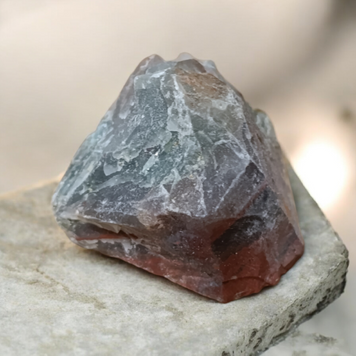
Raw stones and crystals are minerals that have had minimal processing: a rough chunk, a polished slice, or a geode with crystals inside. Unlike sculpted shapes or tumbled stones, these show a mineral's natural structure exactly as the earth made it.
The same product gets searched for as raw stones, as raw crystals, and as stones in their natural form. The wording changes, the point stays the same — minimal human interference with the shape.
How nature builds the structure you see
A geode starts as a hollow space inside rock — a gas bubble trapped in cooling lava, or a cavity carved out by groundwater in sedimentary rock. At this stage, minerals have nothing to do with it yet.
Groundwater rich in dissolved silica or other minerals then seeps through cracks into that hollow space. As the water cools or evaporates, the mineral precipitates out in thin layers on the inner surface — one layer at a time, crystals grow inside the geode.
That same layering process is also what creates agate's banded pattern. A polished slice is exactly where you can see how many layers built up over the stone's whole formation. Small geodes with a thin crystal lining form over tens of thousands of years; large collector-grade specimens take millions.
Raw chunk, slice, or geode — what each format shows
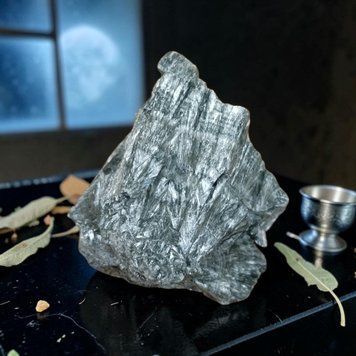
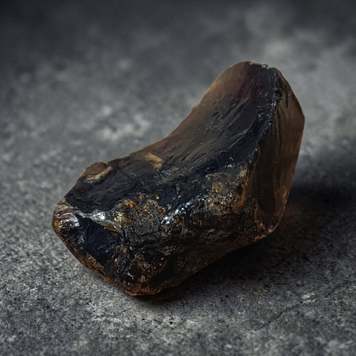
A raw chunk keeps the outer shape the mineral grew into or broke off with — natural facets, sometimes a bit of the host rock still attached.
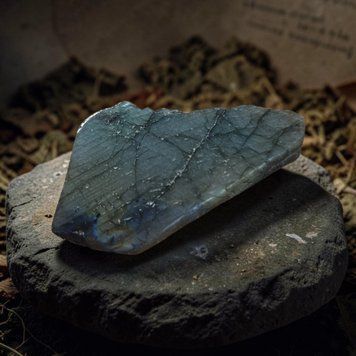
A polished slice cuts the stone in half and reveals what you can't see from outside: the layered structure, inclusions, the color pattern within.
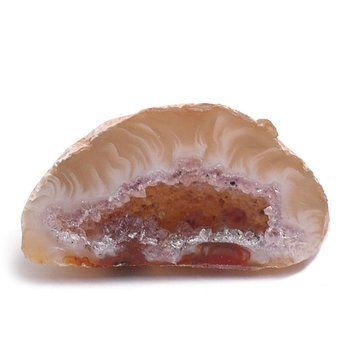
A geode stays whole on the outside, and the main event hides within: a cavity lined with crystals, visible only where the geode has been cut or opened.
What minerals the raw stones come in
The format is one of three, the mineral can be almost anything in the catalog. The most common range covers five types.
|
Mineral |
Format example |
What sets it apart |
|
Amethyst, citrine |
raw crystal |
A natural crystal face, showing the mineral's growth |
|
Labradorite, agate |
slice (S–XL) |
The internal pattern and sheen only show in a cross-section |
|
Agate |
geode |
A crystal-lined cavity, unremarkable from outside |
|
Amber, obsidian, tiger's eye |
raw chunk |
A natural shape with no cutting or polishing |
|
Lapis lazuli, heliotrope, fluorite, calcite, kyanite |
raw chunk, small format |
A compact size for a collection or an altar |
The size and shape of every raw specimen is unique — even two chunks of the same mineral never fully match each other.
Choosing a format for your purpose
If the mineral's natural shape is what matters, a raw chunk represents it most faithfully, with no intervention at all.
If the internal structure is what draws you in — layers, inclusions, a shift in color — pick a polished slice. It's the only format that shows what's hidden inside the stone.
A geode fits when the surprise of the shape itself matters: a plain-looking stone with a crystal cavity inside.
A consultation can help pick the format and mineral
The catalog carries raw stones in three formats and dozens of minerals — easy to get lost in, when it comes to which version actually shows what interests you. A consultant checks the specific mineral and format before you order.
- Honest advice on format — chunk, slice, or geode — based on what you actually want to see.
- Original minerals only, checked before they enter the catalog.
- Orders are processed and shipped the same day.
- The loyalty program gives a cumulative discount from one to ten percent, promo codes through the newsletter, and a separate discount on the shop's birthday.
- Help matching size to placement — from a pocket-sized slice to a large collector's piece.
Raw stones and crystals at Artifacts of the Vedun get bought for a collection, for an altar, and as gifts for anyone who values a mineral's natural beauty. Price depends on mineral, size, and format — from 95 hryvnias for a small raw chunk to nearly a thousand for a large polished slice. If you're unsure which format fits, a consultant can advise in chat before you order.
Questions about raw stones
How is a raw stone different from a tumbled one?
A raw stone keeps its natural facets and the shape of its break. A tumbled one has been processed specifically to smooth the edges and give the stone a rounded, pleasant-to-touch shape.
Why do two slices of the same mineral look different?
Every natural mineral grows in its own way, so the pattern, layer thickness, and internal color are unique to each specific stone — even within the same deposit.
What does a geode show if it isn't cut open?
Almost nothing from the outside — a geode often looks like an ordinary, unremarkable rock. The crystal cavity only shows where a geode has already been opened or sawn.
Does a raw stone degrade over time or from light?
No, a stone's mineral structure is stable. The exception is a few minerals sensitive to direct sunlight, which can lose a bit of color saturation — a consultant can say whether that applies to a specific stone.
How are stones shipped abroad, and can I pay on delivery?
International shipping runs through Nova Poshta and Ukrposhta, with cash on delivery available for a 150-hryvnia prepayment toward shipping.