




|
Quantity
|
Total
|
||
|
|
|||
|
|
|||
A woodcarver may keep a dozen knives on the wall, each with its own purpose. The same applies to an altar: athames, ritual knives, sickles and needles cut or inscribe, and each has its own task. An athame draws the circle and directs energy. A knife cuts herbs and cords, a sickle harvests herbs, and a needle inscribes symbols in wax. A common mistake is using an athame to cut herbs when it serves an entirely different purpose. Many people are also surprised by the stone blades, some of which are carved entirely from natural stone.
What an athame is used for
A ritual circle begins with the movement of a hand, usually holding an athame, a ceremonial blade. It is used to direct energy, draw a magical circle and invoke the guardians of the four directions. Its point traces a line in the air, invisible to the eye, and everything that follows takes place within it. In Wicca, the athame is considered the main ritual tool, and it is also used in ceremonial magic, neo-paganism and witchcraft. The handle is often black and the blade is often double-edged, though neither is a rule. Symbols on the handle are chosen by the owner or their tradition, making the athame a personal sign. Choose a handle that rests comfortably in your hand, so that you can trace the circle with confidence and its symbol feels like your own.
The history of the athame can be found in old books. The word appears in The Key of Solomon, a Renaissance grimoire, which means that a ritual blade by this name has been known for several centuries. In the 1950s, Gerald Gardner called the athame the most important tool of the New Forest coven and wrote that the blade was "not for actual physical cutting." An athame works within the ritual and does not touch stems or cords.
A blade has a ritual companion, and that is the cup. In some traditions, they stand side by side on the altar as a union of opposites: blade and vessel. Once your athame has found its place, you can choose a matching piece from the cups.
How an athame differs from a boline
An athame traces the circle like a finger across misted glass: the mark remains while the glass stays whole. Nothing is cut with it during the ritual, so a separate knife called a boline is kept nearby for herbs or cords that need cutting. The three altar blades may look similar in shape, but each has its own purpose.
| Blade | Purpose | Available forms |
| Athame | ritual work, drawing the circle, directing energy | metal with a pentagram and moon phases, 7 cm blade; obsidian |
| Ritual knife (boline) | physical cutting during ritual work | steel, deer, goat or roe deer antler handle, 11.5-15 cm blade |
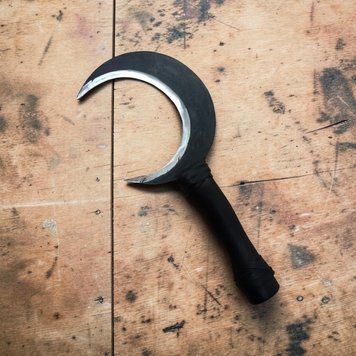
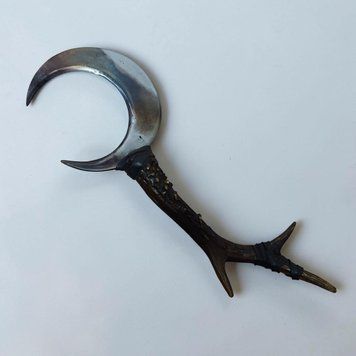
| Sickle | harvesting herbs | steel, wood or roe deer antler handle, 10-20 cm blade |
The purpose of a blade can be seen in its edge. A cutting knife needs sharp steel that will handle both a dry stem and a thick cord. An athame has no need for sharpness, which is why it can be made from stone. Its purpose is to draw a line in the air.
Keep a pair on your altar. Let the athame remain for the circle, while the knife or sickle handles anything that must be cut by hand. The antler-handled knives and sickles are handmade: "Guide" with a deer antler handle and an 11.5 cm blade, "Boundary of Worlds" with a goat antler handle, and the "Waxing Moon" sickle with a roe deer antler handle and a short 10 cm blade. A sickle is convenient for cutting stems for a sachet or bundle, while a knife will handle dried herbs from your supplies. The athame remains within the circle.
Materials used for ritual blades
Blades are forged from steel, carved from natural stone or cast in metal with symbols, and the material suggests what task the blade is meant for. Steel is made for working with your hands. It cuts stems, cords and thread, so it is chosen when something needs to be cut during a ritual. The handmade ritual knife "The One That Cuts Away" has a goat antler handle and a 15 cm blade. The forged witch's knife is made entirely of steel, with a blade reaching 22 cm. Handmade knife and sickle handles can be made from deer, goat or roe deer antler, each with its own natural pattern.
Stone is taken from the earth, and on an altar it serves as a sign. Knives are carved from obsidian, amethyst and selenite. These include an obsidian athame with a 9.5 cm blade, an amethyst knife and the "7 Chakras" selenite knife. Selenite is a variety of gypsum with a hardness of only 2 on the Mohs scale, so a fingernail can leave a mark on it. A stone blade is not used for cutting. It is given a place on the altar and protected from impacts.
On a cast athame, the symbols are moulded directly into the metal. The "Pentagram and Moon Phases" athame is decorated with a pentagram and moon phases, measures 15.5 cm in length and has a 7 cm blade in bronze or silver colour. A compact athame fits both on a small altar and on a shelf. Like stone blades, it is made for the circle and the altar, while a steel knife is convenient to keep beside it for hands-on work.
What a ritual needle is used for
Before a ritual, an inscription appears on the candle before the flame. A needle is used to carve symbols and words directly into the wax. The carved word burns together with the candle, and many practitioners see this as a way to make an agreement with the world before the first spark. A person's name, a rune or a sigil, a personal sign containing an intention, is inscribed as a fine groove on a spell candle. The wax needs to be firm enough for the line not to crumble. You can find a suitable candle among candles and candle holders.
In witchcraft tradition, this tool has its own name: a burin. This is the name for a thin metal rod with a handle, although "awl" would be more precise. It is used to carve images and words into candles. Needles with a human or raven skull are also available, handmade from metal and polymer resin. Such a burin takes its place on the altar beside the athame.
The candle and the symbol suggest the right needle length. Short needles with points around 3-5.5 cm suit thin candles and small runes. Thick needles with an 8 cm point move more steadily through broad wax. For a large candle and a larger inscription, there is the "Feather" needle with a 12 cm point. There are no strict rules, and we hope you find the needle that lets you inscribe a sign without haste or trembling.
Buy an athame at Artifacts of the Vedun
It is hard to explain in words which blade will feel right in your hand, so if you have doubts, it is best to resolve them before buying. Message the store's practitioners on Viber, Telegram or WhatsApp, or call us. Tell them what you plan to do, whether you want to draw a circle or cut herbs, and they will tell you directly if the chosen knife is unsuitable. If you are in Kyiv, visit the showroom at 2 Bessarabska Square, Metrograd Shopping Centre, entrance from Khreshchatyk. There, you can hold a knife in your hand and feel the weight of its handle.
Before placing an order, these details may be useful:
- Advice is provided by practitioners who work with the knives, sickles and needles sold in the store.
- Some knives and sickles are handmade, with handles made from deer, goat or roe deer antler.
- Returning customers receive cumulative loyalty discounts.
- Orders are dispatched on the same day they are placed.
- Nova Poshta and Ukrposhta deliver across Ukraine and abroad, courier delivery is available in Kyiv and the surrounding area, and self-collection is also possible. All terms are listed on the payment and delivery page.
You can choose an athame, knife or needle from the store's range. The price depends on the material and handmade work and ranges from 125-5950 UAH, from a small candle needle to a handmade sickle with a roe deer antler handle. The website has a minimum order amount. If you are unsure which blade will suit your hand, message the practitioners before ordering.
Frequently asked questions about athames and needles
Which element does an athame correspond to?
In Wicca, the athame is usually associated with fire, while in ceremonial magic it is associated with air. Traditions do not share one universal answer, and this is not a contradiction: each has its own system of four ritual tools, with the blade assigned its own place. Once you know which system you use to draw the circle, the athame's element becomes clear.
Do I need to cleanse a new athame before the first ritual?
No, it is not required. The practitioner decides this for themselves. One person passes a new blade through smoke or leaves it on the altar overnight, while another draws a circle with it straight away. Both approaches are familiar for an athame, so follow the practice that feels closer to you.
Can I use a regular sewing needle instead of a ritual needle?
Yes, a sewing needle is enough for a small symbol on a thin candle. If you need a long line on a large candle or firm wax, a ritual needle is more convenient because it has a handle and sits more securely in your hand.
Can I pay for a ritual knife on delivery?
Yes, by cash on delivery at the post office, with an advance payment required. You can read about this and other payment methods on the payment and delivery page and choose the option that suits you.