








|
Quantity
|
Total
|
||
|
|
|||
|
|
|||
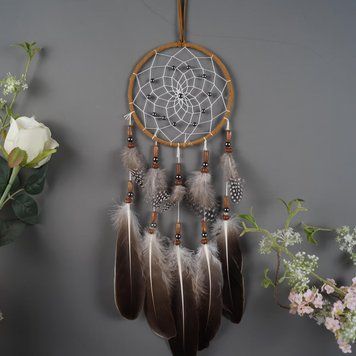
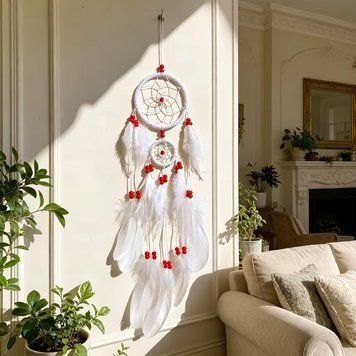
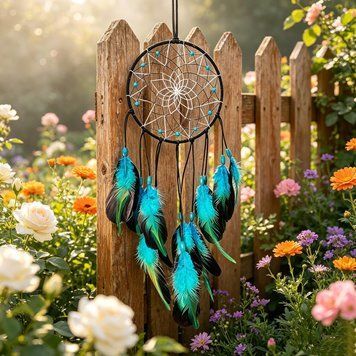
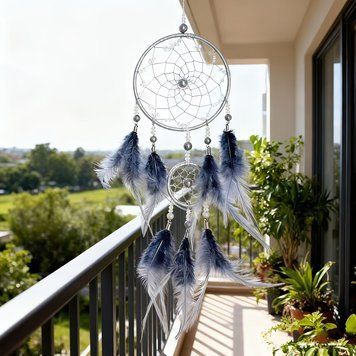
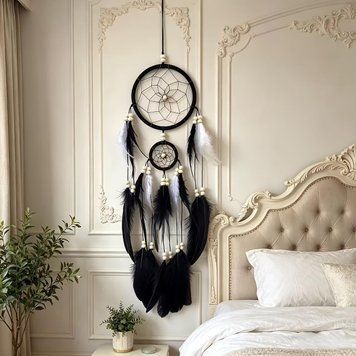
A dreamcatcher is a woven ring with a web inside and feathers hanging below it, traditionally hung above where someone sleeps. Bad dreams get caught in the web, and good dreams pass through the hole in the center to the sleeper.
The same object gets searched for as a dreamcatcher, as a dreamcatcher charm, and as a dreamcatcher amulet. The wording differs, the shape stays the same.
Where the dreamcatcher comes from
The dreamcatcher is a tradition of the Ojibwe, an Indigenous people of the Great Lakes region of North America. According to legend, Spider Woman, Asibikaashi, cared for the whole Ojibwe people, but as the tribe grew and spread out, she found it harder to keep up with everyone.
So Ojibwe women and grandmothers began weaving protective webs of their own, from willow branches and thread made of nettle fiber — to carry on Asibikaashi's work in places she could no longer reach herself.
The dreamcatcher's mechanism is usually described this way: bad dreams get tangled in the web and dissolve in the morning sunlight, while good dreams pass through the central hole and slip down to the sleeper. The feathers under the ring traditionally act as a kind of chute the dream slides down.
Why chakras, a pentagram, or other symbols get added to the web in this catalog
A traditional dreamcatcher is a ring, a web, and feathers. Modern versions often add another layer of meaning to that base — a color, a symbol, or a mineral that reinforces the owner's specific intent.
A chakra dreamcatcher combines the base function of filtering dreams with the colors of the seven energy centers — from root red to crown violet, following the system Charles Leadbeater fixed back in 1927.
A pentagram or an «Eye» adds an even more specific protective accent — the same symbol that works as a standalone amulet elsewhere is woven here into a structure that's already catching negativity.
What versions of dreamcatchers the catalog carries
The base is the same, the decoration varies. The catalog covers a few directions.
|
Type |
Catalog example |
What sets it apart |
|
Classic symbolic |
«Spirit of Nature», «White Magic», «Ladder to the Priesthood» |
A traditional shape with a themed decoration |
|
Chakra |
«7 Chakras», «Chakras», «Chakra Pyramid» |
The colors of the seven energy centers |
|
With an added symbol |
«Silver Pentagram», «Eye», «Heart» |
A protective or emotional symbol at the center |
|
With feathers |
a dreamcatcher with a pheasant feather |
A pronounced decorative feather, closer to the traditional shape |
|
Colored |
rainbow |
An aesthetic accent with no added symbolism |
Size and the length of the weaving vary between models — from compact pieces to long, multi-tiered constructions.
Choosing a dreamcatcher for your purpose
For a classic version closest to the tradition, pick a model with feathers and simple weaving, with no extra symbols.
For working with the energy centers during sleep, a chakra version fits.
If an extra protective accent is needed, symbolic models with a pentagram or an eye combine the dreamcatcher's function with a specific charm.
A consultation can tell you which dreamcatcher fits
The catalog carries dozens of decoration options — a consultant can help work out which model fits the purpose before you order.
- Honest advice on the symbolism of a specific model.
- Original pieces only, checked before they enter the catalog.
- Orders are processed and shipped the same day.
- The loyalty program gives a cumulative discount from one to ten percent, promo codes through the newsletter, and a separate discount on the shop's birthday.
- Help with placement above where you sleep.
Dreamcatchers at Artifacts of the Vedun get bought for the home and as gifts. Price depends on size and decoration — from 325 hryvnias for a compact model to 1,350 for a large chakra pyramid. If you're unsure which model fits, a consultant can advise in chat before you order.
Questions about dreamcatchers
Is a dreamcatcher a symbol of a specific people, or a generic charm?
It's an Ojibwe tradition, an Indigenous people of the Great Lakes region of North America, tied to the legend of Spider Woman Asibikaashi. Modern decorative versions with chakras or a pentagram are a later addition on top of that base.
Where's the right place to hang a dreamcatcher?
Above where you sleep, or near a window that gets morning sunlight — by tradition, it's the morning light that destroys the bad dreams caught in the web.
Does a dreamcatcher need any special care?
No special care is needed, just protect it from moisture and physical damage to the web. Feathers can be gently shaken free of dust.
Does a chakra dreamcatcher work differently from a regular one?
The base function is the same; the centers' colors add another layer of meaning — working with the energy centers during sleep, on top of the traditional dream filtering.
How are dreamcatchers shipped abroad, and can I pay on delivery?
International shipping runs through Nova Poshta and Ukrposhta, with cash on delivery available for a 150-hryvnia prepayment toward shipping.