





|
Quantity
|
Total
|
||
|
|
|||
|
|
|||
Celtic God Statues
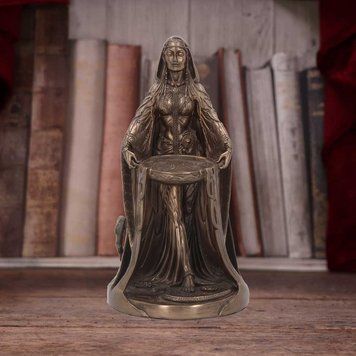
Celtic god statues include figures of Cernunnos, Morrigan, Danu, and other gods of the ancient Celts. They are placed on a nature altar and used for Wheel of the Year festivals, giving each season its own face and name.
The voices of the druids have not reached us in written form, as they passed their knowledge on orally. Stories of the gods survived in medieval Irish and Welsh manuscripts. Place a figure on your altar when the forest deepens its shadows, the earth wakes from sleep, or it is time to give thanks for the harvest. This gives the power of the season a clear sign within your home.
What We Know About Celtic Gods
The memory of Celtic gods has reached us by three paths: through the writings of Roman authors, inscriptions and images, and Irish sagas and the Welsh Mabinogion. Druids passed knowledge orally to their students, so few texts created by the Celts themselves have survived. Stories changed from voice to voice, as a river changes its course, yet the images of the gods remained in the memory of tradition.
Irish sagas lead to the Tuatha Dé Danann, the tribes of the goddess Danu, who came to Ireland with arts, magic, and knowledge. Dagda, Danu, and other Irish deities belong to this circle. Welsh traditions preserved Ceridwen and Arianrhod, while the Mabinogion gave these stories a different language and pattern of fate despite their shared roots.
Today, the traits of the gods are carefully gathered from fragments until their pattern appears again. Antlers, a cauldron, ravens, a wheel, or a torc - a neck ring of power and dignity - help a statue convey a modern interpretation of the deity. Let the figure beside you remind you which force you are addressing and which season resonates with it.
How to Read the Symbols on Celtic Figures
On a Celtic figure, an animal, object, or ornament serves as a marker along the road. These symbols show which god the image is devoted to, what force it represents, and with what intention it is placed on an altar.
|
God |
Symbols |
Sphere |
|
Cernunnos |
Stag antlers, torc, animals around him |
Nature, abundance, wild power |
|
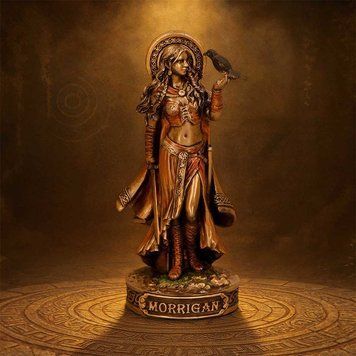
Morrigan |
Ravens, spear |
Fate, battle, prophecy |
|
Ceridwen |
Cauldron |
Wisdom, transformation, inspiration |
|
Dagda |
Club, cauldron of abundance, harp |
Prosperity, order of the seasons |
Cernunnos's stag antlers hold the memory of nature, which grows according to its own law and asks no permission. His image is suited to work with abundance, the earth, and living wild power. Morrigan's ravens appear at the threshold where a decision already changes a person's path. Place her figure nearby when you want to see the consequences of your chosen path more clearly. Fate speaks through the actions we are ready to take. Ceridwen's cauldron holds the quiet simmer of thought until former understanding ripens into knowledge.
Danu is seen as the mother of the gods, connected with water, earth, and the nourishing source. Arianrhod is associated with the silver wheel, stars, time, and fate, so her figure belongs beside lunar notes or reflections on the cycles of life. If a symbol resonates with you, give it a purpose in your practice so that the figurine reminds you every day of the force you have chosen.
Why Cernunnos Is Called the Horned God
A stag sheds its antlers and grows them again when its time comes, and this movement of nature is reflected in the image of Cernunnos. He is called the god with stag antlers, the lord of the forest and animals. The antlers speak of maturity, the ability to protect one's space, and the renewal of strength each year.
In old depictions, Cernunnos sits among animals holding a torc in his hand. The best-known image is associated with the Gundestrup Cauldron, while his name survives in an inscription. The torc, a neck ring of power and dignity, together with the antlers indicates status, connection with the earth, and the right to be master of one's own place.
The yearly cycle places the Horned God beside the Goddess in modern practice and Wicca. He is born, reaches fullness, gives away his strength, and departs with the fading of nature. Cernunnos is addressed when natural masculine power, abundance, bodily steadiness, and closeness to the forest are needed. A 22.5 cm ash wood figure of Cernunnos stands well among branches and acorns, while bronze-finish figures measuring 22, 26, or 30 cm bring a seasonal arrangement together around one centre.
Daylight and natural materials create fitting surroundings for a Cernunnos figure at home. Place it where stones, branches, or other finds from your walks are kept. In autumn, leaves, antlers, and cones work well beside it, and the statue will remain a living part of your yearly cycle.
What the Cauldron Means in Celtic Magic
A cauldron holds fire and water in one vessel until separate elements ripen into something new. In Celtic magic, it speaks of transformation, inspiration, abundance, and the birth of life. Herbs need time to steep, water must receive heat, and an intention must take shape.
In Welsh tradition, Ceridwen brewed a potion of wisdom in her cauldron for her son. The first drops accidentally went to the servant Gwion and brought him knowledge, while a series of transformations led him to become the bard Taliesin. This story leaves a clear reminder for practice: inspiration changes a person, and the previous form may become too narrow afterwards.
Dagda's cauldron promises land that feeds everyone who comes to it: no one leaves it hungry. Beside it lives the image of a cauldron of rebirth, where what has ended becomes the beginning of the next path. When work or life enters a period of change, a figure of a god with a cauldron helps keep attention on the process of ripening while the result is still unseen.
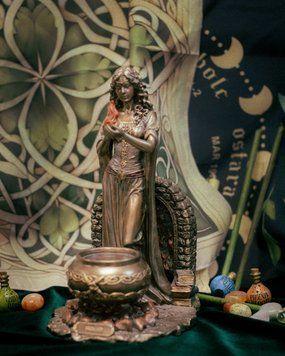
On an altar, a 17 cm Ceridwen figure or an 18.5 cm Dagda the King figure can be placed beside a small cauldron for herbs and a note with an intention. Let the note hold one clear thought, so the cauldron gathers your direction rather than scattering it among many wishes. After the ritual, herbs can be returned to the earth, bread left for birds, and the note kept until your intention is fulfilled or burned in a candle flame.
How Celtic Gods Are Connected to the Wheel of the Year
The Wheel of the Year turns like soil in a garden: it first holds darkness, then releases growth, brings maturity, and gives up the harvest. Four fire festivals mark these changes, and each has its own patrons. Let the figure on your altar correspond to the season you are currently walking alongside.
Each festival has its own character, though an altar does not have to follow one fixed arrangement:
- Samhain arrives at the end of October, on the boundary between the old and new year, together with remembrance of ancestors. In tradition, Dagda and Morrigan meet at this time, so bread, water, and a burning candle can be left near their figures.
- Beltane opens May with flowering, fertility, and the physical strength of nature. Cernunnos resonates with this time, when growth is already visible in the soil, branches, and grass.
- Imbolc brings the first movement after winter silence. Clear water, early branches, and intentions ready to sprout support this festival well.
- Lughnasadh brings the first harvest and gratitude for what has been grown. Here, Danu recalls the earth that gives food and support, so offerings from the field and garden suit a place beside her figure.
The moon returns to the sky in familiar phases, and Arianrhod is suited to rites where you observe time and recurring cycles. Danu is placed near gifts of the earth when giving thanks for a home, the body, food, and the gathered harvest. The Wheel of the Year does not require statues to be moved for every festival. One figure can remain in its place while offerings, words, and signs of the season change around it.
Where to Place a Celtic Figure and How to Honour It
Let the figure stand where the home remembers the breath of the earth: by a window, near living plants, or on a seasonal altar. Wood, stones, and dry leaves will feel fitting beside it, as Celtic gods are connected with water, animals, and the soil from which everything rises.
Branches, acorns, antlers, seasonal leaves, and stones found along the way will create the figure's own language around it. On an altar, bark and moss suit Cernunnos, dark feathers or stones suit Morrigan, and a bowl of water suits Danu. Leave some free space near the statue so each object keeps its own voice and the figure does not disappear among other things.
An offering is like a sign for a guest who is remembered and awaited. In modern practice, milk, honey, bread, clean spring water, or a candle flame are left for the gods. Pour water beneath a tree or onto the ground, give bread to birds, and return milk and honey to nature where they will not harm soil or animals. Let a candle burn out under supervision, then clear the space calmly.
The year changes the earth's clothing, and it is useful for the figure's surroundings to change with it. In spring, place sprouts and light-coloured fabric nearby; in autumn, grain, leaves, and dry branches; in winter, evergreen needles, water, and candles. If the statue needs dusting or moving, do it as part of ordinary care for your space.
How to Choose a Celtic God Figure
A figure on an altar keeps before your eyes the promise you carry through the coming months. It may be growth, protection of boundaries, wisdom, prosperity, or connection with the earth, while the season, size, and material help it find the right place.
Before ordering, consider several things:
- Purpose and god. Cernunnos is suited to natural power and abundance, Morrigan to work with fate and decisive changes, Ceridwen to inspiration and inner transformation, and Dagda to prosperity. Outer beauty matters, but the figure should have its own place in your ritual.
- A god and goddess pair for the yearly altar. Cernunnos can be placed beside Danu or Arianrhod when you want to unite natural power with earth, water, time, and the lunar cycle. An altar does not require such a pair, though this image helps maintain the balance your season needs.
- Material. Ash wood brings a warm, living texture and lightness. Bronze-finish polystone feels heavier and retains crisp details, while standard polystone suits a neat figure without a bronze coating. Let a wooden statue remain visible among dark objects, and leave enough open space around a bronze figure on an intimate altar.
- Size. A height of 17-18.5 cm is convenient for a compact altar, while figures measuring 22-30 cm become the central image of an arrangement. Measure your shelf or surface in advance so that the statue does not block candles, a bowl, or other important objects.
A 22 cm Morrigan, 22.5 cm Danu, and 24 cm Arianrhod suit a noticeable seasonal centre, while a 30 cm Cernunnos needs more open space around it. Prices for available Celtic figures are approximately 2950–4950 UAH. Let your choice answer the work of your current season, and Celtic god figurines will support your altar every day, not only on festival days.
Choosing a Celtic Figure with Guidance from a Practitioner
When an image already resonates with you, it is useful to consider it without rushing. Our practitioners can help select a figure through the available contact channels, while those near Kyiv can see ash wood and bronze in person. The showroom is located at Bessarabska Square 2, Metrogard Shopping Centre, with an entrance from Khreshchatyk Street.
- Consultations are provided by practitioners who work with the items they describe.
- A loyalty programme with cumulative discounts is available to regular customers.
- Orders are dispatched on the day they are placed, under the terms stated at checkout.
- Nova Poshta and Ukrposhta deliver orders across Ukraine and abroad; courier delivery and collection are available in Kyiv.
- Orders can be paid for by card online, by bank details, in cash at the shop, or by cash on delivery with a prepayment.
A Celtic god statue is worth buying when you already know where it belongs on your altar and within your yearly cycle. The figures cost approximately 2950–4950 UAH. Write to us before ordering if you want to compare height and texture or understand which god is closer to your festival and intention.
Frequently Asked Questions About Celtic Gods
How does Celtic mythology differ from Norse mythology?
They are different traditions with different peoples and pantheons. Norse stories have survived in the written Eddas, while Celtic traditions must be assembled from Irish sagas, Welsh legends, inscriptions, and images.
Who is Morrigan, and is it dangerous to work with her?
No, if you approach her respectfully and understand your intention. Morrigan is connected with fate, battle, and prophecy. Her image is addressed during periods when it is important to see the truth of a situation, strengthen boundaries, and make a decision without self-deception.
Which Celtic god should I choose for abundance in the home?
Dagda is chosen for this purpose. His cauldron of abundance carries the theme of food, prosperity, and the order of the seasons, so bread, grain, or a note with a specific household goal can be left beside the figure.
Do the Celts have a goddess of the moon and stars?
Yes. Arianrhod is connected with the moon, stars, time, and fate. Her figure can be placed on a lunar altar beside silver-coloured objects, water, or notes about cycles.
Can I pay for a figurine when I receive it at the post office?
Yes. A figurine can be paid for by cash on delivery when received through Nova Poshta or Ukrposhta with a prepayment. The prepayment amount and other payment terms are confirmed when placing the order.