





|
Quantity
|
Total
|
||
|
|
|||
|
|
|||
Slavic god statues
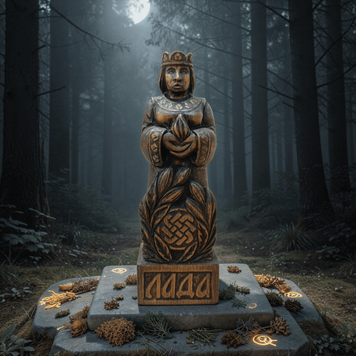
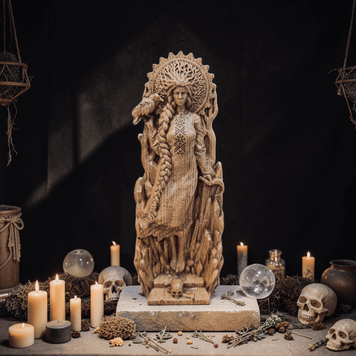
Slavic god statues bring the images of Perun, Veles, Mokosh, and other ancient Slavic deities into the home. They are placed as patrons of the family line, one's work, or protection, giving an appeal a visible focus.
Above the Dnipro, on a Kyiv hill, stood the first known pantheon of Slavic gods: Prince Volodymyr placed wooden idols there. A household figure continues this tradition of remembrance. People turn to it in difficult times, give thanks for prosperity, and ask for peace within the family.
Fate responds when a request is spoken clearly. Let your home altar hold a deity whose sphere feels close to you and is easy to understand.
What is known about Slavic gods
Information about Slavic gods has survived like cloth with only some threads intact: it appears in chronicles, treaties, accounts by foreigners, and folk rites. No single book preserving the full pantheon of the ancient tradition has survived, so the image of each god is formed from several sources. This knowledge calls for a thoughtful approach, while at home one can address the gods with respect and remember their place within the family line.
The Primary Chronicle preserves the memory of Prince Volodymyr's Kyiv pantheon: Perun, Khors, Dazhbog, Stribog, Simargl, and Mokosh. Perun's wooden image had a silver head and golden moustache. When the Rus' made treaties with the Greeks, they swore by Perun and Veles, and such an oath was held more firmly than an ordinary promise.
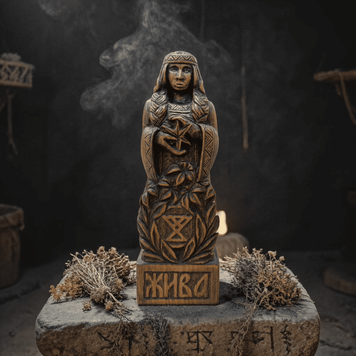
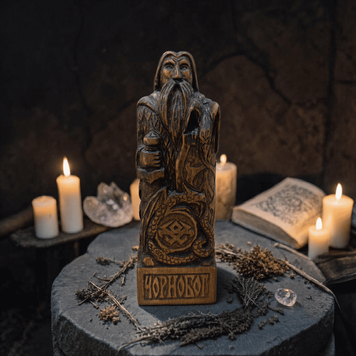
The West Slavic lands preserved foreign accounts of Svyatovit and Chernobog. Lada, Zhiva, certain pairs of gods, and many images connected with fate were later reconstructed from songs, rites, and folklore. Tradition remains in people's hands like a warm object passed down by elders: in festive food, household words, the memory of ancestors, and objects kept within the family.
Why Slavic gods are carved from wood
Wood carries a path from roots in the earth to branches in the sky, which is why Slavs gave their gods carved forms. Idols stood at shrines, while ancestral churs were kept in the home. Warm wood responds to the hand through its living texture. Place a figure where you need to remember a task you have begun and the reason it was started.
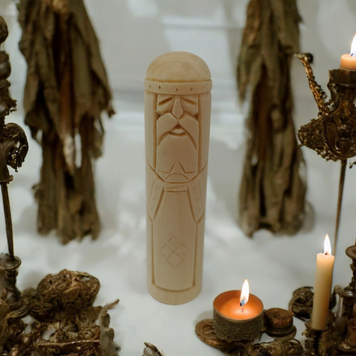
At the shrine, the community honoured the gods, brought them offerings, and gathered for festivals. An idol conveys the image of a deity and its strength, while a chur guards the boundary of a family, home, or land. A chur is also called a guardian. It is well suited to a place by the entrance, near a plot of land, or beside reminders of ancestors.
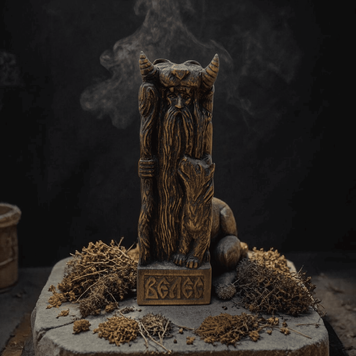
Oak has long been associated with Perun, while linden and birch are linked with female and ancestral images. Modern carving continues this thread: 20 cm alderwood figures retain the calm, earthly solidity of living material. Handcrafted Veles and Perun figures made from polyurethane resin with moss create another image: a god stepping from forest shadow with the breath of the woodland around him.
Who is Perun
In Slavic tradition, Perun rules thunder and lightning. His image belongs where a person needs to hold boundaries, protect loved ones, and answer for their word. We suggest placing his figure by the entrance or where important decisions are made, as a daily reminder of composure and inner support.
Perun held the foremost place in the Kyiv pantheon. The oak, axe, and thunder sign resembling a turning wheel speak of his strength, while Thursday is considered the day of the thunder god. On this day, you can thank Perun for endurance and ask him for clarity in a difficult matter.
Scholars see the confrontation between Perun and Veles as a myth of the storm: thunder pursues the serpent, lightning strikes, and then rain comes to bring fertility to the earth. This story recalls that strength leaves a mark and requires responsibility for its consequences. A 20 cm alderwood figure of Perun or a 21.5 cm handcrafted figure works well by the entrance, in a workshop, or in a workspace where you maintain order and care for your work.
What Slavic gods are responsible for
Each god has their own sphere in the human journey, and a home image is chosen for the place where support is needed. A home altar keeps intention in sight. Place the figure where you will encounter it every day.
|
God |
Sphere |
Suited for |
|
Veles |
Livestock and wealth, magic, wisdom, the world of ancestors |
Those who manage a household or business, practitioners |
|
Svarog |
Heavenly fire, blacksmithing |
Craftspeople and creators |
|
Rod |
Family line, ancestors, birth |
Families and ancestral work |
|
Mokosh |
Fate, spinning, women's crafts |
Women, homemakers, and craftswomen |
|
Stribog |
Winds, travel, news |
Travellers |
Veles guards what comes into the household and the memory of the ancestors behind the family line. His image will feel close to those who run a business, work with prosperity, or practise magic. Svarog's fire resembles a forge where an object is born through patient hands, so he is placed near a craftsperson's workspace. Rod gathers the family around a shared root, while Mokosh guides the thread of fate through household care and women's crafts.
Lada and Zhiva are remembered through images of love, spring, and continuing life. Mara comes with winter, death, and completion, when what has run its course must depart. Belobog and Chernobog hold light and darkness, good fortune and misfortune, as two sides of the road, helping a person see the whole path, including its sunlit slope.
How to honour Slavic gods at home
Home worship rests on simple things, just as a hearth rests on firewood and the attention of its keeper. Bread, words, festivals, and remembrance of the family line give it support. A figure does not require a complex ritual: it is enough to know whom you are addressing and what you wish to ask. You may place bread, honey, grain, milk, or kvass nearby, and light a candle or oil lamp in the evening.
The year follows its own cycle and reminds us who deserves time. At Koliada, people often turn to Veles; in summer, they honour Perun; at Kupala, they give thanks to the forces of growth and fire; and at Masnytsia and the farewell to winter, they remember Mara. The autumn Dedy days return a person to their ancestors, family memory, and the continuation of the line through the living.
Words spoken from the heart sound steadier than borrowed solemnity. Give thanks for what you already have, speak openly about your request, and leave room for the actions through which an answer may come. Slavic amulets may lie beside the figure, or there may be only a candle and a bowl for offerings. Let your way be respectful and clear to you.
Where to place a Slavic god figure
The image of a god needs its own corner, where it will not disappear among random objects. Place the figure on a clean, stable surface and give it a permanent spot, so that a home shrine begins with attention rather than the habit of filling a shelf.
- Rod belongs near family photographs, where it is easier to remember ancestors and address them in thought.
- Mokosh suits a kitchen or handicraft corner, where the day is shaped by work, care, and patience.
- Find Perun a place by the entrance or in a workshop, where his image recalls the boundaries of the home and firmness in work.
- Place Veles near money, documents, or on a desk where business is conducted and the results of work are reviewed.
- Give Svarog a place by the hearth, stove, or in a workshop, where fire, craft, and making things are part of the daily rhythm.
Several figures can stand on one shelf, forming a home shrine. Leave space between them for a candle, bowl, or small offering, and arrange the images securely so they do not obscure one another. The shelf will then retain a clear order with room for both family and work.
How to choose a Slavic figure
Let the needs of your family and home come first, followed by material and form. A patron arrives as a promise supported by actions, so it is worth considering several simple points before ordering.
- Let your purpose lead you to the right god. The image will then answer a genuine need rather than remain a random decoration with a meaning that does not belong to you.
- Decide in advance whether you need one figure or a pair. Perun and Veles hold strength and prosperity, Belobog and Chernobog recall the fullness of light and shadow, while Rod and Mokosh connect the family with fate. This will make the composition feel complete.
- Material gives the image its character. A single 20 cm alderwood series brings the pantheon together in one style, while the 22 cm Veles and 21.5 cm Perun resin figures with moss create a more textured, woodland feel. Let the chosen figure suit the place you have prepared for it.
- Light and dryness preserve wood better than long speeches. Keep the figure away from radiators and direct heat so that the surface does not dry out and the carving retains its living softness.
The price range for these figures is around 2995–4995 грн. Slavic god figurines are chosen with the heart, while the home benefits from forethought: measure the shelf in advance and decide whether there will be a candle or offering beside it.
Choosing a Slavic patron together
It is important to feel a wooden figure in your hands before it takes its place at home. Write to us, and a practitioner will advise you on items in the range. In Kyiv, you can view a statue in person at the showroom at Bessarabska Square 2, Metrohrad Shopping Centre, entrance from Khreshchatyk.
- Questions are answered by practitioners who work with items from our store.
- A loyalty discount programme is available to regular customers.
- Orders are dispatched on the day they are placed when shipping conditions are met.
- Nova Poshta and Ukrposhta deliver across Ukraine and abroad, while courier delivery and collection are available in Kyiv.
- Orders can be paid for by card online, bank transfer, cash in the store, or cash on delivery with a prepayment.
A Slavic god statue is brought into the home when it is already clear whose presence you would like to see beside you each day. The price guide is 2995–4995 грн. If you would like to confirm the image of the god, material, or place for a home altar before ordering, write to us.
Frequently asked questions about Slavic gods
Can Mara and Chernobog be placed in the home?
Yes. When a period is coming to an end, a home may need an image that helps acknowledge change and let go of what has been lived through. Mara and Chernobog are placed with a clear intention to complete a task, endure a difficult time, or leave the past behind. These forces mark the boundary beyond which the next stage begins.
How does a chur differ from a god figure?
A chur is a guardian of the home, family line, or a defined boundary, and it does not belong to the pantheon of gods. Its place is where a space needs protection, while a deity figure directs attention to a particular force: family, craft, or thunder.
Can Slavic gods be kept beside gods from other peoples?
Yes. Different images can stand together when you know whom you are approaching and with what intention. Give them a shared, calm shelf or separate places so that the meaning of each image does not dissolve among the others.
How should a wooden figure be cared for?
Wood preserves its carved pattern for a long time when it is kept away from water, heat, and harsh light. Place the figure in a dry location away from radiators and direct sunlight, and remove dust with a soft, dry brush, moving lightly over the carving without pressure.
Can I receive a figure through Ukrposhta?
Yes. Ukrposhta delivers figures across Ukraine and abroad. When placing an order, select this delivery method and check whether your local branch is available.