




|
Quantity
|
Total
|
||
|
|
|||
|
|
|||
Everything that will go onto charcoal for incense or into a ritual pouch first passes through a mortar. Under the pestle, herbs, resins and salts become a single blend. What you can grind in it depends on the material, so choose a mortar for the mixtures you have in mind. In practice, grinding is considered part of the ritual, which is why blends are prepared by hand. The mortar is kept on the altar beside the herbs.
How mortars entered folk beliefs
Baba Yaga in Slavic tales is never without her mortar. She flies in it, steers it with a long, thick pestle, and sweeps away her tracks with a broom. The mortar is so closely linked with the pestle and broom that Yaga is recognised by them before her face is seen. In some tales, her mortar is made of iron.
Among the people, the mortar remained a witch's object. At the same time, a mortar and pestle are considered among the oldest household tools. Grain, salt and herbs were pounded in them long before mills and coffee grinders appeared.
On an altar, a mortar carries on the same fairy-tale image. It belongs to someone who knows herbs and prepares blends from them by hand. Beside bowls, candleholders and other altarware, it remains a working item.
What materials mortars are made from
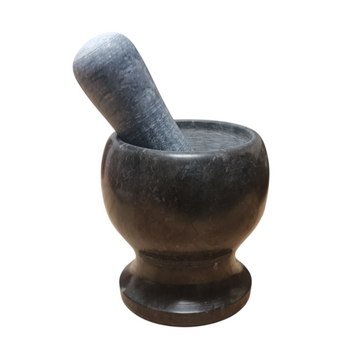
A mortar bowl remembers everything ground in it, and the depth of that memory depends on the material. Mortars are made from granite, marble and wood.
| Material | Does it absorb odours? | Best suited for |
| Stone (granite) | absorbs very little | resins, salts, hard seeds |
| Wood | permanently absorbs oils and odours | soft dried herbs |
| Marble | porous and may stain | light herbs |
If frankincense was ground in a wooden bowl yesterday, today's lavender will carry its scent too. Wood is highly porous and absorbs oils forever, much like the walls of an old house retain stove smoke no matter how often they are aired out. Marble is also porous and can stain. Granite has almost no pores, is heavy, and handles hard spices and resins well. After washing, it retains very little of previous scents.
Resins and salts work well in stone. A wooden mortar suits a single herb, where there is no other scent to mingle with it. A heavy stone bowl stays steady on the altar while you press into the pestle, so there is no need to hold it in place. Soft herbs grind easily in it. Hard resins and powders can be ground firmly in a mortar of this size without anything spilling over the edge.
How to grind herbs in a mortar
An even grind comes from taking your time, working with small amounts, and moving the pestle in circles with pressure. This keeps the blend inside the bowl rather than scattering it across the altar. The work proceeds this way, from the first handful to the finished mixture.
- Start with a small handful so the herbs have enough room. When the bowl is filled to the brim, the mixture jumps over the edge, while the bottom layer gets crushed and the top remains untouched.
- It is best to break up anything hard beforehand. Press seeds and resin lumps firmly with the pestle several times until the first crack appears, then begin grinding.
- Then move the pestle in circles, leaning your full weight into it and working along the base and sides. Random strikes are unnecessary here.
- Grind resin and salt separately from herbs. Each component needs its own grind, and they are mixed only once ready.
- Stop when the grind is right for the mixture you intend to make. It can be anything from coarse crumbs to dust, depending on the blend.
For burning on charcoal, a finer grind is needed. Fine crumbs smoulder evenly, while larger stems flare up one by one. For a pouch, the grind can remain coarse. The herbs will release their scent longer, and the fabric will not become covered in dust. If the mixture is intended for both charcoal and a pouch, set some aside after the coarse grind, then continue grinding the rest.
How to care for a stone mortar
Unpolished stone absorbs almost like a sponge. Its walls are covered with tiny pores, and everything that enters them remains inside. Soap settles in these pores and may later show up in the scent of the next blend, so wash the bowl with warm water and a stiff brush. Dry it straight after washing, along with the pestle, then leave it to air-dry.
If resin has soaked in and will not come out, mix baking soda with water into a paste. Apply it to the brush, scrub the walls, and rinse with warm water. Granite should not be soaked, even when a stain is stubborn, because water enters its pores just as soap does.
Handle a marble bowl more carefully. Vinegar can etch its surface and make it lose its smoothness, so keep acidic cleaners away from it. A clean, dry bowl will not mix the scents of two rituals, and each blend will smell only of what you put into it.
Buy a mortar from Artifacts of the Vedun
Questions about whether a bowl is large enough for your blend or whether a particular stone suits your herbs and resins are best asked of a real person rather than guessed from a description. The shop's practitioners answer via Viber, Telegram and WhatsApp, as well as by phone. If a mortar does not suit your request, they will tell you directly. They can recommend a material that will work best for specific herbs and resins. If you are in Kyiv, you can hold a mortar in your hand and feel its weight in the showroom at Bessarabska Square 2, Metrograd Shopping Centre, entrance from Khreshchatyk.
A few details about the terms:
- you speak with practitioners who prepare their own blends and see how resin behaves under a pestle;
- regular customers receive accumulated discounts;
- orders are dispatched on the day they are placed;
- mortars are delivered by Nova Poshta and Ukrposhta across Ukraine and abroad, by courier in Kyiv and its suburbs, or can be collected from the shop;
- payment can be made conveniently by card online, bank transfer, cash on delivery with a prepayment, or cash in the shop.
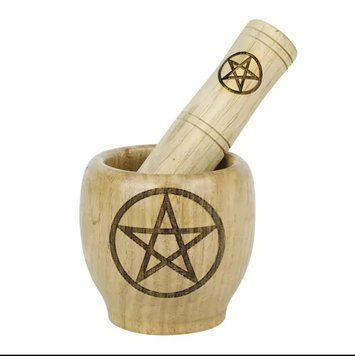
Choose a mortar for the work it will do. The price depends on the bowl material and its decoration, so smooth stone and a bowl carved with a symbol are priced differently. If you are unsure about the size or material, message the shop before ordering and a practitioner will select a mortar for your blend.
Frequently asked questions about mortars
Do I need to cleanse a new mortar before the first ritual?
No, it is not necessary. A new bowl is ready to use straight away. You can rinse it with warm water before your first blend or begin grinding without any preparation. Choose whichever feels more convenient.
How can I remove the scent of resin from a stone mortar?
A handful of dry white rice ground in the bowl can help. The rice absorbs residual oils along with the scent. Empty out the powder, add a fresh handful, and repeat until the rice no longer darkens after grinding.
Can I grind salt and minerals in a mortar?
Yes. The descriptions of our mortars mention salts, resins, ash and minerals alongside dried herbs. For coarse salt and hard minerals, choose a stone bowl because it absorbs almost nothing and withstands firm pressure from the pestle.
Do you ship mortars abroad?
Yes, we ship with Nova Poshta and Ukrposhta.