






|
Quantity
|
Total
|
||
|
|
|||
|
|
|||
Dark Deity and Demon Statues
A dark deity statue embodies Baphomet, Lilith, Lucifer, and other figures from demonology and occult tradition. It is placed on an altar for shadow work, rituals, and meditation when the force you are addressing needs a visible form. An intention without an image can disperse like smoke through an open window, so a figure before your eyes helps you focus on passion, anger, or the thirst for knowledge and face them honestly. The world responds to a clear call, while a demon statue remains on the altar as a sign of your inner work rather than a random dark interior detail.
Who are called dark deities
Dark deities include spirits and figures connected with the repressed side of human nature: anger, passion, death, forbidden knowledge, and chaos. The name does not pass judgment but describes experiences that can be difficult to accept without self-deception. The shadow holds impulses that can destroy, as well as forces from which change can grow when faced directly.
An altar figure holds attention the way fire holds the gaze in a dark room. During meditation or ritual, it helps you remain with one question: fear, hunger for power, repressed sexuality, anger, or the longing for freedom. The experience takes shape, making it easier to return to without inner distraction.
The Left-Hand Path centres on personal will, responsibility for one's choices, and self-knowledge. This path does not erase the consequences of actions or demand that you pretend to be fearless. Let the practice lead you towards honest knowledge of your own boundaries: the decision remains yours and should not be handed over to someone else's image or a passing mood.
Where demon imagery comes from
Images of demons have travelled a long road from ancient Near Eastern traditions through medieval grimoires and into modern practice. Their names passed from myths into religious texts and magical books, with every era leaving its mark on them. This is why one figure may appear as a spirit of illness, a tempter, a ruler of passion, or a symbol of an inner trial, depending on which layer you are reading.
In Mesopotamian traditions, the night side of the world spoke through lilitu spirits associated with illness, danger, and freedom without restraint. Jewish traditions brought their own figures of demons, angels, and forces standing between worlds. These stories did not form a single teaching: they came together from different sources, and it is worth keeping that history in mind when an image seems contradictory.
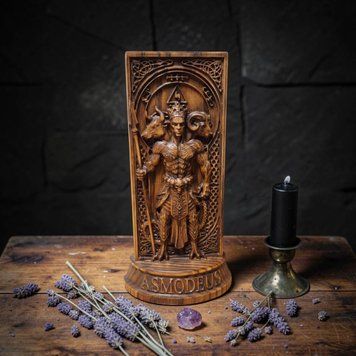
Medieval and Renaissance grimoires gave these names an orderly form in systems of invocation and command. The Goetia names demons, their seals, and spheres of influence: Asmodeus is linked with passion and desire, Mammon with wealth and the power of money. In the 19th and 20th centuries, occultists began to see such figures as forces within the person, while literature introduced new images into this circle: Lovecraft's Cthulhu is a literary character addressed by some chaos magic practitioners.
What the image of Baphomet means
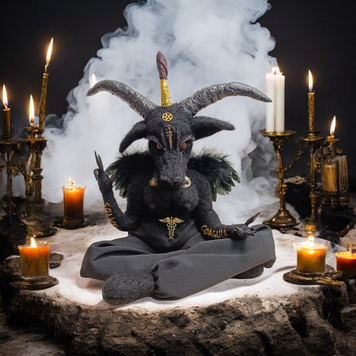
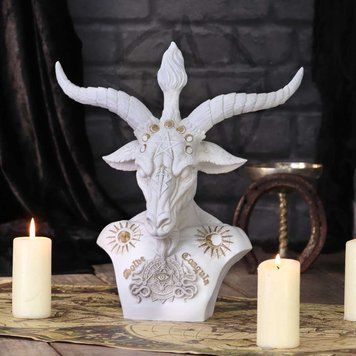
In the figure of Baphomet, opposites meet like two banks joined by one bridge: male and female, light and darkness, human and beast. The canonical image was created in the 19th century by the French occultist Eliphas Levi, while the name Baphomet appeared earlier in accusations against the Templars. This figure helps you examine inner conflict without self-condemnation and understand what to do with it next.
Every feature of the figure speaks its own language:
- The goat's head recalls instinct and nature, the part of a person for which reason alone is not enough.
- The pentagram on the forehead gathers the will into clear, directed consciousness.
- The torch between the horns raises the light of understanding above animal nature, allowing instinct to be seen and understood.
- The hands pointing up and down connect the higher with the earthly and speak of the old breaking apart so that something new can take shape.
- The wings let consciousness rise above familiar views while keeping its footing in reality.
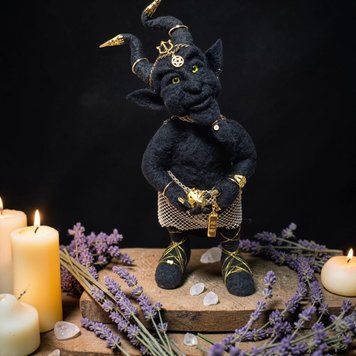
Ash wood, felt, and the height of the figure change Baphomet's presence in a space as different weights change the sound of a bell. A black ash Baphomet, white and black busts 33 cm high, handmade felt figures of 22 and 30 cm, and a large 38 cm Baphomet suit work with balance, accepting your shadow, and transformation. For contemplative practice, you can place a Baphomet from the Cult Cuties collection, where the image is complemented by a connection between the upper and lower worlds.
What demon figures are used for
Every demonic figure has its own voice and area of work, so choose a statue for the quality you want to uncover within yourself. A name on the altar gathers thought as a frame gathers a picture: it holds the chosen theme and prevents it from dissolving into anxiety. Let one figure remain at the centre of your practice until your intention takes clear shape.
|
Figure |
Origin |
What it is used for |
|
Lilith |
Mesopotamian traditions, the medieval legend of Adam's first wife |
Independence, feminine strength, sexuality |
|
Lucifer |
The name means "light-bearer" and was used for the morning star |
Knowledge, the light of reason, rebellion against what is imposed |
|
Asmodeus |
Jewish traditions, the Goetia |
Passion, desire |
|
Mammon |
Medieval demonology |
Money and its power |
|
Samael |
Jewish mysticism |
Trial, severity, death as a boundary |
|
Cthulhu |
Lovecraft's literature |
Chaos, the unconscious |
One figure at a time keeps inner work on course when strong emotions arise. An ash Lilith can stand beside work on personal boundaries, while a handmade 31 cm Lucifer can be chosen for reflecting on knowledge and independent decisions. A handmade 26 cm Samael, a 41 cm wool Mammon, and a 24 cm Cthulhu also call for precision: give the figure one question rather than expecting an answer for your entire future.
A demonic image leaves the choice in your hands, just as a mirror leaves a person with their own reflection. Write down your question before meditation and reread it afterwards to distinguish your own thought from an emotional surge. Themes of endings and loss may also lead you to death deities, but in this practice, stay with the image you began with.
Light figures in occult tradition
An altar becomes more complete when it has room for different sides of the path. Alongside demonic figures, we present angels and ancient goddesses: occult tradition also turns to light figures. They can be placed where you need order, the completion of a task, vitality, or a return to yourself.
The inner world is not divided by a clean line between what is comfortable and what is not, and the world responds to a clear gaze without such a line. Light figures help preserve this wholeness in practice: they let you see different directions of work without turning away from parts of yourself.
How to work with a demon figure on an altar
A demon figure helps hold your attention on the force you have chosen to work with, and it deserves the same respect as any image on an altar. An altar separates everyday matters from time for yourself, so give this practice a steady rhythm and do not try to force an intense experience at any cost.
The sequence may be as follows:
- Begin with a question that is ready to be voiced. State in one or two clear sentences what you want to understand or change within yourself.
- Give the figure its own calm place. Set it on a separate shelf or altar, away from foot traffic, household bustle, and other people's hands.
- A candle nearby gathers attention as a small flame gathers the gaze at dusk. Place a black or red candle, and add the spirit's seal if needed. Black candles suit work with shadow and boundaries.
- Address the image in your own words or sit before it in meditation. Keep in mind the question with which you began.
- After the practice, write down what remains with you: sensations, thoughts, dreams, or decisions you have made.
- Closing the practice returns the day to its usual rhythm. Thank the image, extinguish the candle, and close the work so that you do not carry the ritual state into everyday life.
The figure itself does not attract evil: its direction is set by your intention and how you address it. You can wipe away dust, move it to a more suitable place, or leave it on the altar without any additional actions. Calm matters more here, because it makes it easier to hear yourself.
How to choose an occult statue
A statue has its place in your daily rhythm, like an object your hand reaches for at the right moment. Let the image answer the theme you are ready to work with, while its size and material suit your altar and your usual rhythm of attention. Then the occult figure will remind you of your chosen direction without unnecessary words.
Before ordering, it is worth checking a few things:
- Purpose and image. A figure gains personal meaning when it is connected to the theme of your current work. Give it one clear intention, otherwise it will remain a beautiful symbol with no connection to your practice.
- Colour. White and black Baphomet show different sides of one force. White supports clarity and balance, while black leads attention deeper into shadow work. Let the colour match the mood of your altar.
- Material. Ash wood works well for understated figures around 18.5 cm high. Polystone and bronze-effect polystone create weighty, detailed forms, while polyurethane resin appears in handmade pieces measuring 25-31 cm. Handmade felt and wool make soft figures up to 41 cm, so it is best to get a sense of their character in advance.
- Size. Figures 16-24 cm are usually suitable for a home altar. Statues measuring 30-41 cm become the centre of a composition, while a large image on a narrow shelf can make both altar care and the practice itself more difficult.
The price depends on size, material, and handmade work and is approximately 2066-5999 грн. If an image speaks to you through the symbols and archetypes of shadow practice, complement it with dark Tarot decks: let one theme unite your readings and meditations.
Why it is better to choose a dark image with a practitioner
A dark image calls for a calm perspective and an understanding of what you want to work with. Our store's practitioners advise on the tools presented here based on their own work with them. If you are nearby, visit our Kyiv showroom at 2 Bessarabska Square, Metrohrad Shopping Centre, entrance from Khreshchatyk: there you can view the statue closely and hold it in your hands.
At Artifacts of the Vedun, we maintain clear conditions for such purchases:
- The tools and figures presented in the store are explained by practitioners who work with them themselves.
- A cumulative discount programme is available for returning customers.
- Under the store's conditions, an order can be shipped on the day it is placed.
- Orders across Ukraine and abroad are delivered by Nova Poshta and Ukrposhta, while courier delivery and pickup are available in Kyiv.
- Orders can be paid for by card online, bank transfer, cash in the store, or cash on delivery with a prepayment.
A dark deity statue is worth buying when you have already found a place for it on your altar and understand the theme of your work. The price of the figures is approximately 2066-5999 грн and depends on the material, height, and handmade work. Contact us before ordering if you want to match an image with your intention and choose the right size for your altar.
Questions about demons and occult figures
Is it dangerous to keep a demon figurine at home?
No, a demon figurine is not dangerous in itself. It is placed for reflection and practice, so keep a clear intention beside it and leave no room for anxious expectations.
How does white Baphomet differ from black Baphomet?
White Baphomet speaks of clarity and the balance of light with shadow, while black Baphomet turns towards depth, protection, and shadow aspects. Both images unite opposites, so choose the one closer to the theme you are living through now.
Do I need to perform a ritual before placing a figure on an altar?
No, no mandatory ritual is needed. Place the figure in your chosen spot and name your intention, saving more complex practice for a time when you have a reason for it.
Can an occult statue be given as a gift?
Yes. If you know the person's relationship with the image and its tradition, such a gift can become a personal item for working with symbolism.
Can I see the figure in person before buying?
Yes, you can view the figure in the Kyiv showroom. Seeing it nearby makes it easier to sense its size, material, and the presence of the image.