









|
Quantity
|
Total
|
||
|
|
|||
|
|
|||
If a Tarot deck is already in your hands, or you've watched a spread being read even once, you already know the main thing. The cards don't work like a lottery — they're read through order, position, and the way they sit next to each other.
Tarot originated in Northern Italy in the 15th century, at the courts of dukes — an ordinary card game for the aristocracy. The occult reading came later. By the 18th century the deck had already become firmly established in the esoteric tradition, and since then the game layer and the practical layer have existed side by side.
How the Tarot deck is structured
The Tarot deck is built from two blocks, and it's worth keeping this division in mind before reading a spread. The Major Arcana are twenty-two cards, from the Fool numbered zero to the World numbered XXI. They carry archetypal stories: the hero's journey, turning points, major life themes. The Minor Arcana are the remaining fifty-six cards, split into four suits of fourteen cards each. Each suit contains: the Ace, number cards from two to ten, the Page, the Knight, the Queen, and the King.
Each suit governs its own area of life, and when a suit card turns up in a spread, it immediately narrows the question down to a specific sphere.
-
Wands — will, action, initiative
-
Cups — emotions, intuition, relationships
-
Swords — mind, conflict, decisions
-
Pentacles — matter, resources, finances
These magical Tarot cards aren't used only for spreads — people work with them in meditation, in journaling practice, as a focal point before an important decision. The form of use expands with experience, but the structure stays the same: 78 cards, two blocks, four suits.
How people work with Tarot cards
A spread is a way to ask the cards a specific question and get a structured answer. Before laying out the cards, the deck is shuffled and the question is formulated mentally (or out loud) — the more specific the question, the clearer the answer.
|
Spread size |
When it fits |
What it shows |
|
One card |
A quick daily question, a guide for the day |
The general tone of the situation, without details |
|
Three cards |
A question with development over time, or cause and effect |
Past, present, and likely future, or situation, action, and outcome |
|
An extended spread (for example, the Celtic Cross) |
A complex question with several influencing factors |
The full picture: causes, hidden influences, likely outcome |
An Arcanum in a spread doesn't work in isolation from its dictionary meaning — its meaning is completed by what lies next to it. A card to the right or left changes the reading of the first one — this rule holds always, without exceptions. A spread is read like connected text, where each card answers the one before it.
Shuffle the deck the usual way, draw one card and lay it face up, then draw a second and place it to the right of the first. Say the Fool comes up first, and the Ten of Swords second. These cards don't read separately. The Fool speaks of a beginning that pays no mind to risk. The Ten of Swords speaks of an ending that was inevitable. Side by side, they form a single message. The old stage is closed for good, and what looks like a start from zero actually begins only after the previous chapter has already run its course.
What kinds of Tarot decks exist
Tarot is published by dozens of authors and publishers, but almost every deck fits into four major traditions, each with its own logic of symbolism. The structure of 78 cards and the division into Arcana stays common to all of them — what changes is the artistic language and how much of a narrative scene each card carries. Below are the four schools most often worked with in the showroom.
Rider-Waite
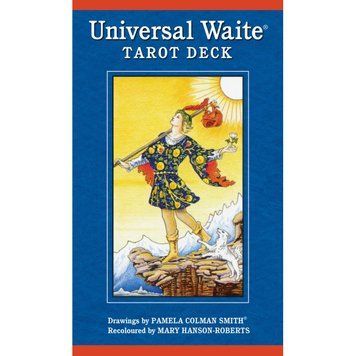
Rider-Waite is the deck most often picked up first. Arthur Edward Waite and artist Pamela Colman Smith created it in 1909 and gave every card of the Minor Arcana a complete scene, whereas in earlier decks these cards carried only the suit and number. That's why a beginner reads the image intuitively, even before opening a book of meanings.
Thoth Tarot by Aleister Crowley
Aleister Crowley worked on the Thoth Tarot together with artist Frieda Harris from 1938 to 1944, and the resulting deck is still considered the most symbolically dense of the classical systems. Astrology, Kabbalah, and Hermetic symbolism are built into the very structure of the cards. Without that foundation, the deck is hard to read.
Marseille Tarot
Marseille Tarot is the oldest living line of decks, its lineage tracing directly back to French editions of the 17th–18th centuries. The Minor Arcana cards here have no scenes: just the suit and number, like in a playing-card deck, and the whole meaning is read through the symbolism of the suit and its position in the spread. That makes Marseille Tarot more demanding of the practitioner and, at the same time, more flexible — the interpretation isn't dictated by an illustration.
Independent decks
Beyond the four classical systems there are hundreds of independent decks, from reimagined versions of Rider-Waite to fully original worlds with their own mythology. Here it's worth looking at the creator and the publisher: Lo Scarabeo, for example, puts out both the classics and dozens of independent decks at different levels of complexity. Before buying, it's worth taking a look at the cards in person or in a review beforehand — an independent artist's symbolism doesn't always match intuitive expectations.
From the first deck to deeper practice
Very different people come to the showroom and to the website. Some are just getting a feel for it and want a Tarot set for beginners, simpler in symbolism — usually that's the starter Rider-Waite. Others have been practicing for years and choose a deck for professional work, guided first and foremost by the accuracy of the symbolism.
A common doubt among beginners is the fear of reading a spread wrong, ruining a card with the wrong reversal, or missing the one correct meaning. Most spreads don't have a single correct answer — there's a more and a less accurate reading, and it comes with practice for everyone without exception. A reversed card is also a full-fledged meaning, read on equal footing with the upright position.
Between these two poles lies gradual expansion. A second and third deck are usually chosen deliberately, for a specific practice task. Next comes the expert advice of those who, in the showroom and in correspondence, help make that choice more precise.
Expert advice on choosing a deck
Here Tarot cards are chosen together with people who themselves lay out these same decks every day — not from the description on the box, but from personal experience working with a specific school. The question of which deck fits your request is answered by someone who knows the difference between Rider-Waite and Marseille Tarot firsthand, not by a generic consultant's script.
Tarot cards at Artifacts of the Vedun are gathered in a single catalog — original editions ranging from the starter Rider-Waite to independent decks in limited runs. The price varies depending on the publisher and the print run. Entry-level decks like Rider-Waite cost less than limited independent series — the exact price is always on the product page. The order is processed and shipped the same day, and if you're unsure about your choice, write to us first — only practicing staff members give advice.
-
The purpose of working with the cards — divination, psychological practice, or collecting
-
Level of preparation — Rider-Waite is suited for starting out, Thoth Tarot is closer to those who already have the basics
-
Whether a companion book is included — many editions come with a booklet of interpretations, which speeds up learning
-
The density and quality of the card stock — a deck for daily work needs to hold up to frequent shuffling
-
Your personal response to the card images — how much the symbolism resonates with you personally is also part of the choice
Besides these personal criteria, there's also what Artifacts of the Vedun offers every buyer regardless of the deck chosen.
-
Only practicing staff members give advice, tailoring it to the specific request
-
Only original editions, no replicas
-
Loyalty program — a cumulative discount of 1–10%, promo codes in the newsletter, a discount on the shop's birthday
-
Order processing and shipping the same day
-
You can come to the showroom and compare the cards in person, if that's more convenient
Questions about Tarot cards
Can I return Tarot cards if they don't work out?
Tarot cards are printed products. Under the law, these goods aren't subject to return within fourteen days — exchange is only possible in case of a factory defect or other flaw. You can check the deck right when you receive your order.
Do I need to specially cleanse a new deck before using it?
During production, a new deck passes through several hands — printing, packaging, shipping. Many practitioners cleanse it before first use with smoke, moonlight, salt, or intention, but that's a personal choice, not a required condition.
What's the best way to start if you've never worked with cards before?
For most people, the first deck is Rider-Waite. Its scene-based Minor Arcana cards read intuitively, with no months of preparation needed. From there you can move on to more symbolically dense systems like the Thoth Tarot.
How does a Tarot deck differ from an Oracle deck?
Tarot has a fixed structure — 78 cards, 22 Major and 56 Minor Arcana with constant suits. With Oracle decks, the structure is set by the deck's own creator, so the number of cards and the reading rules change from edition to edition.
How is an order with Tarot cards processed and delivered?
The order is processed and shipped the same day. Delivery is by Nova Poshta and Ukrposhta across Ukraine and abroad, by courier within Kyiv and its suburbs, or by pickup from the showroom at 2 Bessarabska Square, TC Metrograd, entrance from Khreshchatyk (Kyiv).