



|
Quantity
|
Total
|
||
|
|
|||
|
|
|||
Altar and spirit boards
An altar board holds a sign of invocation on the altar, like a letter left in plain sight. It is a wooden panel bearing a seal, sigil, or image, placed at the centre when addressing the force being invoked. In old grimoires, a spirit's seal was considered its signature, so practitioners would redraw it for each working; a board keeps that sign permanent. The world responds to a clear call, so let your connection with a spirit, deity, or tradition guide your choice rather than random beauty. Ritual boards also include working spirit boards and pendulum charts.
How seals and sigils work on an altar
A seal or sigil brings an invocation into a single line, much as a signature expresses a person through a few marks. Its design contains the name, nature of a spirit or deity, or an intention, and during a working your gaze stays focused on that connection. A full name is unnecessary when the sign is already known to its recipient, so a seal helps you speak clearly without excess.
A paper sigil is usually created for a single action, while a wooden panel remains by the altar for future invocations. Wood quietly receives the passage of time, like a threshold receiving the steps of those returning home. The same board preserves a place, an image, and a familiar way of speaking, making it easier for your intention to hold its chosen form.
Place the panel at the centre of the altar, with a candle and offering in front of it, so the lines of the sign remain in view during the invocation. Avoid surrounding it with many symbols if you want to keep the exchange focused. A suitable place for the board is beside altar tables and cabinets, where the sign remains before your eyes while you work.
What the demon seals of the Goetia are
Goetia seals connect an invocation with the names of 72 spirits described in the grimoire The Lesser Key of Solomon, also known as Lemegeton. Its first part, Ars Goetia, is known from European manuscripts of the 17th century, where each spirit is given a rank, abilities, and its own sign. A seal helps keep attention on a particular name rather than speaking vaguely about dark forces.
During an invocation, the sign remains before your eyes like a marker on a road you have already chosen to follow. It may be held in front of you or placed on the altar for ongoing work. This practice requires time, knowledge of protective methods, and attentive reading of sources. It is best to understand whom you intend to address and why before beginning an invocation.
Each spirit has its own character and design, which may resonate with different intentions. Spirits are associated with a task, descriptions from the grimoire, and a personal response to their image. The 15 cm seal panels include Cimejes, Samigina, Crocell, Auras, and Alloces. Keep one sign for one working with a clear reason, so your attention does not split between several invocations.
Who the Vodou loa are and how they are depicted
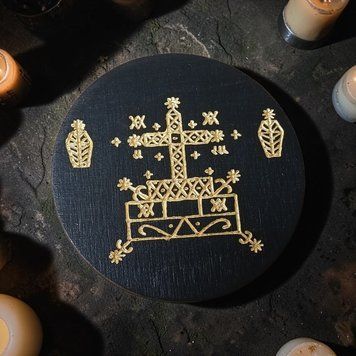
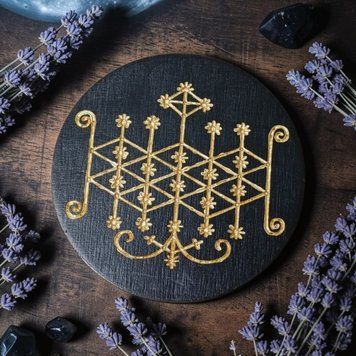
In Haitian Vodou, the loa stand between people and the supreme deity, and each has its own character, colours, and veve sign. A veve is drawn during a ritual when addressing a particular loa, while on a wooden panel it remains a lasting sign of that loa's presence. This tradition continues to live through people and ceremonies, so its images should be kept with respect for their origins.
A panel helps keep the intended recipient of offerings and words clear, just as a name on an envelope protects a letter from falling into other hands. Traditional descriptions include the following figures:
- Papa Legba is the guardian of crossroads, addressed first to open the way to the other loa.
- Baron Samedi is the loa of death and cemeteries, and the head of the Gede spirits.
- Maman Brigitte is Baron Samedi's wife and a patroness of cemeteries and justice.
- Yemaya is the mother of waters and motherhood.
- Ogun is the loa of iron, labour, and war.
Offerings and a veve connect the panel with a particular loa, much as a familiar gesture connects a person with a given word. Keep nearby the gifts traditionally offered to your chosen loa, while allowing the sign itself to retain its traditional context. If the Vodou path is only beginning to open before you, start with books on Vodou and Hoodoo, then decide whether you are ready to address a particular loa. This way, the board remains a sign of respectful work with the loa.
What other signs appear on altar boards
Alongside seals and loa, boards can feature symbols from pagan and modern magical traditions. Such a sign sets the tone of an altar like a tuning fork holds a note. Learn its meaning beforehand, so the image supports your work.
- The Valknut is associated with Odin and passage between worlds, and is used for work in the Norse tradition.
- The Helm of Awe carries the meaning of protection and steadfastness. On an altar, it helps maintain focus and guard boundaries.
- The Elder Futhark forms a runic system for work with runes and galdr.
- Thor, Freyr, and the Three Norns belong to the Norse tradition for invocations to its gods and work with fate.
- The pentagram, triquetra, and Wheel of the Year belong to Wicca and witchcraft, connecting the elements, cycles, and changing seasons.
- Cernunnos, the horned god of forests, suits nature magic and connection with the wild.
- The sigils of Lucifer, Lilith, Hecate, and Santa Muerte serve their respective paths and invocations.
- The symbols of Mercury, Uranus, Neptune, and Pluto are used in practices with an astrological focus.
Choose a board bearing the sign of a force you already work with or are ready to approach after studying its tradition. The Wheel of the Year panel with a snake and pentagram brings together themes of cycles, renewal, and balance between the elements, while the Elder Futhark arranges an altar around runic work. Other images for this path can be found in the dark deities and occult traditions section.
How a spirit board works
A spirit board brings a conversation into a visible circle. Its surface contains an alphabet, numbers, and the words “yes”, “no”, and “goodbye”, while a planchette moves beneath the participants' fingers. Talking boards became a familiar part of spiritualist culture in the late 19th century, and the name Ouija eventually became a common term. The letters and words on the board allow the movement of the planchette to form a readable answer.
Quiet is needed here, like a level table for writing. Hold the session where you will not be interrupted, and let one person guide the conversation with short questions while the others barely touch the planchette with their fingertips. Begin with a greeting and end the work with the word “goodbye”. Every invocation needs clear boundaries at the beginning and end.
A clear question gives the conversation direction, like a light on the road at dusk. Sit at the board with respect and one understandable topic, without expecting a stream of random messages. If calmness fades and the atmosphere becomes unsettling, end the session with the word “goodbye”. For this work, we offer the All-Seeing Eye spirit board, the Might of Baphomet board, and an Ouija board with angels.
How to work with a pendulum chart
A pendulum chart arranges answers into a clear pattern. You hold a pendulum over a board with sectors and watch which one the movement leads toward. A classic chart includes “yes”, “no”, and percentage values. A chakra chart helps examine the state of energy centres, while Magical Influences and Love Magic keep the question within a chosen topic. The labels on the charts are in Ukrainian, and board sizes are 18×18 and 26×26 cm.
Working with a pendulum over sectors requires a steady hand and a clear question. Choose pendulums that feel comfortable to hold by the chain between two fingers, and prepare a table for your work.
- Place the chart on a flat, stable surface. Keep it still so you can see each sector clearly.
- Hold the pendulum chain between two fingers and rest your elbow on the table. This helps your hand tire less quickly and keeps the movement distinct.
- First ask the pendulum which movement means “yes” and “no”. A few trial questions will show its usual direction.
- Keep the question short and unambiguous. One topic in one sentence gives a clearer answer than several questions combined together.
- Hold the pendulum above the centre of the board and wait for it to move toward the required sector. Do not guide your hand, even if you already have a desired answer in mind.
- Write down the answer you receive, and if unsure, ask the same question in different words. These notes help reveal recurring patterns and separate them from a first impression.
How to choose an altar board for your practice
Boards serve two different purposes, so it is best to understand yours before purchasing. A panel bearing an image of a force remains on the altar for invocation, while a spirit board or pendulum chart helps receive answers in a set format. One board only needs to remain in sight, while another must provide a clear field for work.
Clarify several points before choosing:
- The board's purpose. A panel with a seal, sigil, or deity is placed on the altar, while a board with an alphabet or sectors is used for answers. This way, the object serves your action rather than remaining a beautiful but unused item.
- The one your words are addressed to. A spirit, deity, loa, element, or tradition can suggest a symbol for the panel. An image connected with your invocation helps keep it clear.
- Size. A small panel of around 10 cm fits comfortably on a small altar, seals around 15 cm are more noticeable, while larger panels and pentacles take the centre of a spacious altar. Measure the available space in advance so the board does not disappear among other objects or cover them.
- Finish. Natural wood, black and gold, black and violet, or red and black colouring can be matched with the colours of your altar. When the shades support each other, it is easier for the gaze to remain on the sign.
- Stand. A panel can be placed on a stand or hung up if it is easier to see in that position while working. Find a permanent place for the board so it does not end up away from the altar.
- Chart language and size. For pendulum work, clear labels and a format of 18×18 or 26×26 cm matter. Familiar markings make it easier to read an answer without an unnecessary pause.
The Nature Magic three-card board suits altar spreads, the Cernunnos panel suits a nature-focused path, and the Goddess Kali panel is intended for addressing this image. The approximate price of altar and working boards is 295-4650 UAH and depends on size, the complexity of handmade work, and the finish.
Who to consult before choosing a board
If a sign has not yet found its place in your work, message us online. Our practitioners can help relate it to a deity, spirit, or tradition, and can suggest first steps with a spirit board. If an item does not suit your request, we say so directly. Those near Kyiv can visit the showroom at 2 Bessarabska Square, Metrograd Shopping Centre, entrance from Khreshchatyk, to see the carving and colour in person.
- Boards are described by practitioners who work with these tools themselves.
- Handmade work is visible in the details, so most panels are worth taking time to inspect in person, including the carving and finish before choosing.
- We offer a cumulative discount programme for regular customers.
- Subject to store conditions, an order may be shipped on the day it is placed.
- Nova Poshta and Ukrposhta deliver across Ukraine and abroad. Courier delivery in Kyiv and its suburbs, as well as self-pickup, are also available.
- Orders can be paid for online by card, by bank details, or by cash on delivery with a prepayment.
It is worth buying a board when you already know which sign should remain at the centre of your work. The price ranges from approximately 295-4650 UAH and depends on the size and complexity of the work. If you are still unsure whether you need a panel, pendulum chart, or spirit board, message us before ordering.
Questions about spirit and altar boards
Can an altar panel be hung on a wall?
Yes. A panel can be placed above the altar so the sign remains in view during your work. This can be more convenient for a permanent altar because the board does not take up space among candles and offerings.
Can I work with a demon seal without experience?
No, it is best not to rush into an invocation. First become familiar with the spirit, its name, and the context of the Goetia seal, and take time to study protective practices and sources. It is better to approach a ritual with a clear purpose.
Can I hold a spirit session alone?
Yes, you can. However, spirit boards are traditionally used by two or three people. If you are starting alone, a pendulum and chart may feel calmer because they make it easier to keep the question in focus and observe the movement.
What should I do if the planchette does not move during a session?
There is no need to force anything. The planchette may remain still, and the session can be moved to another time. Let the participants check whether their fingers are resting lightly and whether anyone is putting pressure on it.
Do you ship altar boards abroad?
Yes. Nova Poshta and Ukrposhta ship altar boards across Ukraine and abroad. International delivery terms depend on the chosen carrier and the destination country.
Edit HTML visually, clean messy code, and preview your document in one simple online tool.