



|
Quantity
|
Total
|
||
|
|
|||
|
|
|||
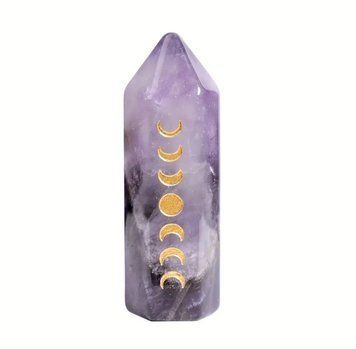
An obelisk is an elongated, four-sided stone shape that tapers to a sharp point. Unlike a sphere, which radiates energy evenly in every direction, an obelisk's shape sends it toward one point - up, through the tip.
The same object gets called a stone obelisk, a crystal obelisk, or a magical obelisk - the word changes, the object doesn't. It's a carved or polished stone shaped like an ancient monument.
Where the obelisk shape comes from
The obelisk shape was devised in ancient Egypt around 2300 BCE, during the Fifth Dynasty. The Egyptians called it a «tekhenu» - «the one that pierces the sky» - and carved it from a single block of stone, most often red Aswan granite.
The sharp pyramidion at the top symbolized a sunbeam touching the earth, while the shaft itself stood as a pillar honoring the sun god Ra. The tip was believed to catch the first and last light of the day, and the monument itself was thought to ward off evil and symbolize rebirth.
Obelisks stood in temple courtyards - that's where the shape carried over into modern crystal work, now without any tie to a specific deity or temple.
Why the sharp shape matters in crystal work
Unlike a sphere, which scatters a stone's properties evenly around it, or a raw chunk or geode, which simply holds them, an obelisk has direction. The sharp tip works like a lens: it gathers the mineral's property and releases it toward one point, upward.
That's why obelisks are often placed where a directed action is needed: on a desk for focus, on an altar as a ritual's focal point, or in a corner of a room with a specific goal.
Size amplifies that effect. A larger obelisk holds more of the mineral's property and reads more clearly in a space; a smaller one suits pointed, everyday use - on a desk, say, or in a pocket.
What minerals the obelisks come in
The shape stays the same, the property belongs to the mineral. The catalog groups obelisks by the purpose a mineral most often serves.
|
Group |
Catalog example |
Property |
|
Protective and grounding |
obsidian, black agate, tiger's eye, red jasper |
Traditionally tied to protection and stability |
|
Calming |
amethyst, angelite |
Traditionally tied to calm and sleep |
|
For mental clarity |
smoky quartz, kyanite, lapis lazuli, rauchtopaz |
Traditionally tied to focus and clear thinking |
|
Multi-stone |
the 7-stone chakra obelisk |
Combines several minerals for a multi-part purpose |
|
Artist-branded series |
«Mystical Story» obsidian (several colors), lepidolite |
A themed series from one maker |
Color and veining within one mineral type vary from piece to piece too - that's normal for natural stone, not a flaw.
Choosing a size and mineral
A desk or bookshelf suits compact sizes - XS and M, small enough to stay out of the way while still standing out.
For an altar or as a standalone accent in a room, people pick L or XL - a larger obelisk reads as its own piece of decor, not just a working tool.
Mineral choice follows purpose: obsidian or black agate for protection, amethyst or angelite for calm, smoky quartz or kyanite for mental clarity. The 7-stone obelisk fits when several properties are needed at once, in one object.
A consultation can tell you which mineral fits your purpose
Stone obelisks at Artifacts of the Vedun get ordered for the home, for an altar, and as gifts. Price depends on mineral and size - from 395 hryvnias for a compact XS to over a thousand for large artist-branded series.
Buying a stone obelisk is easiest after a consultation, especially with a specific goal in mind: a practitioner can tell you which mineral and size actually match the purpose.
- Honest advice on which mineral fits a specific purpose.
- Original minerals only, checked before they enter the catalog.
- Orders are processed and shipped the same day.
- The loyalty program gives a cumulative discount from one to ten percent, promo codes through the newsletter, and a separate discount on the shop's birthday.
- Help matching size to placement - desk, shelf, or altar.
Questions about stone obelisks
How is an obelisk different from a pyramid or sphere in the same stone?
By shape and direction of effect: a sphere scatters a mineral's property evenly, an obelisk and a pyramid direct it through their point. Within the catalog, the obelisk and the pyramid sit side by side but are separate shapes with somewhat different histories.
Does the number of sides on an obelisk matter?
A classic obelisk is four-sided, like the Egyptian original. Variations show up in modern crystal work, but the four-sided shape with a sharp tip remains the most common.
Is the 7-stone obelisk one mineral or a mix?
It's a set of seven different minerals in one object, each layer its own stone. This format fits when several properties are needed at once, in a single piece.
Can an obelisk just be a decor piece, with no ritual purpose?
Yes. The shape and mineral work as a piece of decor regardless of whether the obelisk also gets used in practice.
What payment methods are available when ordering?
Payment is available by card online, by bank transfer, by cash on delivery with a 150-hryvnia prepayment, or in cash at the shop.