




|
Quantity
|
Total
|
||
|
|
|||
|
|
|||
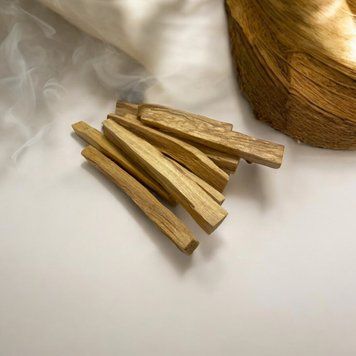
You've probably already held an incense stick or cone and burned it to the end — all at once, with nothing left over. Palo santo works differently. It's a solid piece of Bursera graveolens wood, split from the trunk and cut into blocks. Such a piece is often called a palo santo stick — it's the split trunk of a fallen tree, with not a single added ingredient.
The key difference is in how it's used. A stick or cone is lit once, and there's no going back: it smolders to the end and crumbles into ash. A palo santo block can be put out at any moment and relit a day later, a week later, as many times as you like, until the wood burns away completely. One piece can last several months of regular sessions.
Bursera graveolens: the journey from fallen tree to block
The palo santo tree grows in the dry forests of South America, where scorching sun and scarce moisture force it to store resin inside its trunk. Its botanical name is Bursera graveolens, which translates roughly as "strongly-scented." Raw, freshly cut wood smells faint and nothing like the finished block: the true aroma only emerges after the tree dies and cures.
Harvesting works so that the tree must fall and die on its own — living trees are left untouched, since they haven't yet built up the needed resin. The fallen trunk is left lying on the ground so the wood undergoes natural fermentation: the resin redistributes within the fibers, and the scent becomes dense and sweetly resinous. Only after that is the trunk cut into blocks. This approach makes the harvest sustainable — no one goes into the forest with a chainsaw for a harvest.
Indigenous peoples of South America have for centuries called it the sacred palo santo tree and burned it during space-clearing rituals before important practices. The smoke was believed to be a conduit that lifts heaviness and clears the space for decision-making. This tradition has survived to this day almost unchanged: the block is placed on a fireproof surface, the edge is lit, and the smoke is allowed to fill the room.
Molded incense works differently. There, aromatic raw material is first ground down, mixed with a binder, and pressed into a stick or cone — the finished product no longer has a direct connection to the original piece of wood or resin. Palo santo is simpler in this sense: you burn the same piece of wood that grew on the tree, with not a single added ingredient.
How to tell real palo santo from a fake
A fresh, not-yet-lit block smells faint and indistinct — the full aroma only emerges when it burns, and that's the first sign of authenticity. Here's what to look for so you don't end up buying an ordinary piece of wood sprayed with fragrance.
-
Cold wood has almost no scent — a strong aroma straight out of the packaging more often gives away a sprayed fake.
-
When burned, it releases a sweetly resinous, citrus-pine aroma — warm, with a light tartness, without a sharp perfume note.
-
The cut is uneven, with visible growth rings and dark resinous streaks — a factory-made piece looks too smooth and uniform.
-
The scent after burning comes in waves, growing stronger and then weaker — with fragranced wood, the smell stays even and doesn't change from start to finish.
-
The supplier collects pieces from fallen trees on a legal basis — the harvest is sustainable, and forests aren't cut down for the yield.
Every batch of palo santo is checked before it reaches the catalog
The palo santo market is flooded with fakes — demand is too high and the margin too easy on ordinary wood with added fragrance. We only work with suppliers who confirm the legal harvest and origin of every batch.
Before a block enters the catalog, it's checked for scent when burned, the structure of the cut, and the batch's origin. If even one parameter raises doubt, the batch is not taken on for sale, even if the price is below market.
-
Loyalty program: cumulative discount of 1–10%, promo codes in the newsletter, and a discount on the store's birthday.
-
Order processing and shipping on the same day.
-
Only practitioners provide consultation on choosing a block and how to use it.
-
Delivery via Nova Poshta and Ukrposhta across Ukraine and abroad, by courier within Kyiv and its suburbs.
-
Showroom in Kyiv at Bessarabska Square, Metrograd Mall, entrance from Khreshchatyk — you can smell the wood before buying.
-
Payment online by card, by bank transfer, cash on delivery, or cash in the store.
It's worth buying palo santo where the origin of every batch is confirmed by inspection before sale. The catalog offers blocks of various sizes, from small chips for a single session to large pieces for several months of use. The price of palo santo depends on the weight and size of the block: a small piece costs many times less than a large piece meant for long-term use. You can check availability of the size you need and place an order on the product page or through a consultation with the store's practitioner.
What people most often ask about palo santo
The most common hesitation is about how palo santo actually burns and how to tell it apart from a fake. Answers below.
How to properly light and extinguish palo santo
Hold the block at a 45-degree angle and light one edge with a lighter or match. Let the flame catch for 20-30 seconds, then blow it out. The wood will start to smolder on its own, without an open flame, giving off smoke for several minutes at a time. To put it out, press the smoldering edge against a fireproof surface — a ceramic dish or a stone — and hold it for a couple of seconds until the smoke stops.
Can one block be used multiple times
Yes, and that's the main difference between palo santo and an incense stick or cone. Once you've put out the smoldering edge, the block is set aside and used again next time — a day later, a week later, whenever you like. The wood is used up gradually, session by session, and one block is usually enough for several dozen lightings, until it becomes too short for comfortable use.
How palo santo incense differs from incense sticks
An incense stick or cone is a pressed mixture of aromatic raw material and a binder. It burns once to the end and leaves nothing for reuse. Whole palo santo incense is simpler: it's a piece of wood with no additives, which can be extinguished and relit, with the aroma released through the tree's natural resin.
Do you ship palo santo abroad, and can I pay on delivery
Yes. We ship across Ukraine and abroad via Nova Poshta and Ukrposhta, by courier within Kyiv and the suburbs. You can pay cash on delivery (150 UAH prepayment), by card online in advance, or in cash if you pick up the order at the showroom.