




|
Quantity
|
Total
|
||
|
|
|||
|
|
|||
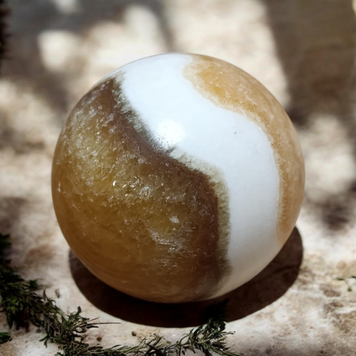
A magic ball is a polished sphere of natural stone that radiates a mineral's property evenly in every direction at once. Unlike an obelisk or a pyramid, a sphere has no point to direct the effect toward one spot.
The same object gets called a magic ball, a stone ball, and a natural-stone sphere. The wording differs, the shape stays the same.
Why a sphere's shape means an even effect
In the geometry of a sphere, every point on the surface sits at the same distance from the center — it's the only shape with that property. That's why a sphere's effect has no direction: it's equally open in every direction at once.
This is the exact opposite of an obelisk or a pyramid, where a sharp tip gathers and directs the effect toward one point. A sphere, instead, scatters a mineral's property evenly around itself.
That's why a sphere is usually placed at the center of a room or somewhere visible — where even distribution matters more than a directed effect aimed at one spot.
Where the tradition of crystal-ball scrying comes from
The oldest mentions of crystals as a divination tool are tied to the Celtic Druids of Iron Age Gaul, Britain, and Ireland, who used beryl for prophecy.
Gazing into a reflective or translucent surface to glean insight is called scrying. By the fifth century CE it was widespread across the Roman Empire, though the early medieval Church condemned it. Similar traditions existed independently among the Egyptians, Persians, Chinese, and Inca.
A modern natural-stone sphere continues that same scrying tradition, though today it's more often used as a meditation object or a source of a mineral's even property for a space.
What spheres the catalog carries
The shape is the same, the mineral and size vary. The catalog covers a few popular options.
|
Mineral |
Sizes in the catalog |
What sets it apart |
|
Smoky quartz, amethyst |
25–40 mm |
Compact, budget-friendly |
|
Agate, black agate, lapis lazuli |
38–50 mm |
Medium size, a bold pattern |
|
Fluorite, apatite, yellow calcite |
50 mm |
Vivid color, a higher price |
|
Garnet, petrified wood |
50–65 mm |
A rare mineral, premium segment |
|
Moonstone, jade, rock crystal |
various sizes |
Classic minerals for a sphere |
A stand for the sphere is a separate item: without one, the ball just rolls, so a wooden or clear acrylic stand is practically required at any size.
Choosing a sphere by size and mineral
A desk or shelf suits a compact 25–40 mm sphere — small enough to stay out of the way while still standing out.
For meditation or scrying, a larger sphere from 50 mm up is easier to work with: the bigger the surface, the easier it is to focus on.
Pick a mineral by the property that resonates personally — smoky quartz for grounding, amethyst for calm, garnet for energy.
A consultation can tell you which sphere and stand fit
The catalog carries more than ten minerals and several sizes — a consultant can help work out the best combination for your request.
- Honest advice on a mineral for a specific property.
- Original minerals only, checked before they enter the catalog.
- Orders are processed and shipped the same day.
- The loyalty program gives a cumulative discount from one to ten percent, promo codes through the newsletter, and a separate discount on the shop's birthday.
- Help matching a stand to a specific sphere size.
Magic spheres at Artifacts of the Vedun get bought for the home, for meditation, or for a collection. Price depends on mineral and size — from 275 hryvnias for a small smoky quartz sphere to 3,450 for a garnet one. If you're unsure which sphere fits, a consultant can advise in chat before you order.
Questions about magic spheres
Does a sphere need a stand, or can it do without one?
Practically required: without a stand, a sphere rolls and can fall. Stands — wooden or clear acrylic — are sold separately for a specific sphere size.
How does a sphere's effect differ from an obelisk's or pyramid's?
A sphere scatters a mineral's property evenly in every direction, while an obelisk or pyramid directs it through their point. Shape sets the direction of the effect, the mineral sets the property itself.
Is scrying with a sphere really an old tradition, or a modern invented image?
It's genuinely an old tradition — the earliest mentions tie to Iron Age Celtic Druids, and similar practices existed independently among the Egyptians, Persians, Chinese, and Inca.
Can a sphere be used with no divination experience, just as a decor piece?
Yes, the shape and mineral work as a standalone decor piece regardless of whether the sphere also gets used in practice.
What payment methods are available when ordering?
Payment is available by card online, by bank transfer, by cash on delivery with a 150-hryvnia prepayment, or in cash at the shop.
Create polished web content with a simple browser-based HTML editor and live preview.