









|
Quantity
|
Total
|
||
|
|
|||
|
|
|||
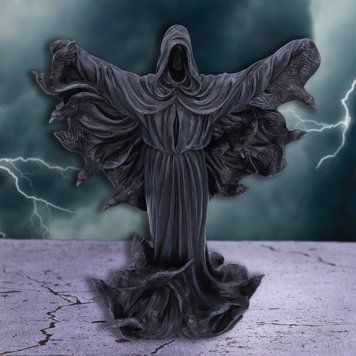
God of Death Figurines
A figure of Santa Muerte, Mara, angel Azrael, or another guardian of transition stands on an ancestor altar like a sentinel at a door that everyone will one day pass through. It is placed beside the memory of loved ones and used when it is time to bring something to a close or let go of the past. Fear of such a figurine is understandable, yet in many traditions death guards the boundary between worlds and accompanies the journey. Change is already asking to enter the home, and this image helps you give thanks for what has been lived and make room for the next stage.
Who are the gods of death
Gods of death guard the place where one cycle of the human path closes and the next begins. They guide souls onward, preserve the memory of ancestors, and remind us of endings. On an altar, such an image helps keep attention on farewell and respect for those who lived before us.
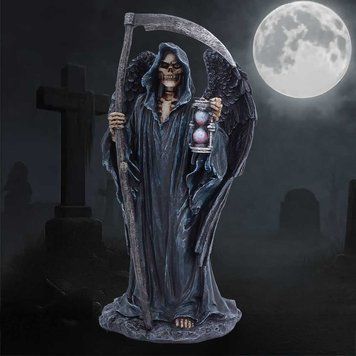
Death appears in different cultures as a guide: an angel, a ruler of the underworld, or the Reaper. The scythe marks the end of a given time, the lantern shows the way, and the scales restore balance. Place the figure where you work with loss, separation, or memory, giving departed time its rightful place.
The earth falls still in winter before spring, and a field after harvest awaits new sowing. In these images, death is therefore connected with rebirth. Mexican Holy Death, the Aztec Mictlantecuhtli, Slavic Mara, angel Azrael, and the European Reaper reveal different faces of the power of transition. Thanatos and Charon belong to Greek mythology, where death also has its own path, boundary, and guide.
Where Holy Death came from
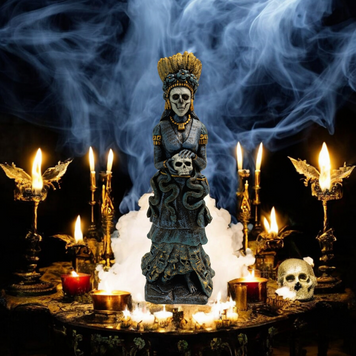
Santa Muerte emerged in Mexico at the meeting point of two traditions: her image united the Aztec ruler of the dead and the European skeletal figure of Death. Her name translates as Holy Death and recalls a force before which all people share equal earthly circumstances. The figure is usually placed where protection, a fair resolution, or quiet support in difficult times is needed.
At the origins of this image stands Mictlantecuhtli, mistress of the underworld of Mictlan and guardian of ancestral bones. The Day of the Dead still carries this thread through flowers, food, candles, and stories about family. The departed are remembered through care rather than silence. A home altar becomes a place of reverence where familiar signs of attention are left for memory.
For a long time, Santa Muerte remained close to people on home altars, and in recent decades her veneration has become more visible and open. There is no single temple hierarchy here, so intention remains in the hands of the individual. People turn to this image with requests for protection, love, connection with ancestors, or the completion of a difficult matter. If this path resonates with you, an 18.5 cm wooden Santa Muerte, a 29 cm bronze-effect figure, or a 25 cm handmade Mictlantecuhtli can take its place on the altar.
What Santa Muerte's attributes mean
The robe and objects in Holy Death's hands gather a request into a clear sign, much as a seal gathers the meaning of a letter. Each attribute names the theme of an appeal, so for the altar it is best to choose one that speaks of the ending, protection, or acceptance you are ready for.
|
Attribute |
Meaning |
|
Scythe |
Cuts away what is no longer needed and marks the harvest |
|
Globe |
Authority over the world of the living |
|
Scales |
Justice and balance |
|
Hourglass |
Time and its allotted span |
|
Owl |
Wisdom and sight in the dark |
|
Lamp |
Light along the way |
The colour of the mantle also guides the request, as if a thread led the hand toward the right pattern. In folk tradition, white is associated with cleansing and protection, red with love and passion, black with strong protection, and gold with money and material stability. Let this colour remain near the altar in fabric or a black candle so that the intention does not scatter into different words.
How the Slavs saw off winter with Mara
Mara, also called Marena, guards the time of winter, nature's sleep, and death that is seen off to clear the way for spring. The old cold recedes gradually, like snow from the ground, and a figure of Mara helps name what has already ended and asks to be released.
At the end of winter, people in different regions committed a straw Mara to fire or set her afloat on water. Sometimes this rite was held in summer during Kupala. Fire and water carried away winter's stillness, leaving room for movement and growth. Mara was approached without hostility because she passed through her own part of the yearly cycle.
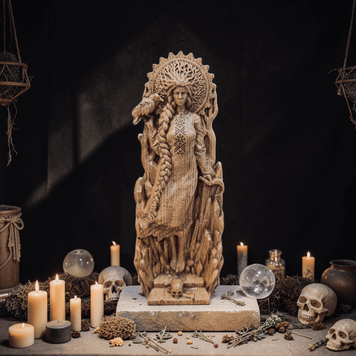
In Mara's image, the death of nature stands alongside its future rebirth. People turn to her with loss, the ending of an outworn bond, or work with dreams. A 20 cm wooden alder figure of Mara will find a quiet place beside notes, a candle, or offerings for ancestors. Other images from this cycle are gathered in the Slavic mythology section.
Why Death is depicted with a scythe
A scythe moves through ripe grain in one even sweep, and this gesture became the basis for the image of death gathering the harvest of lives. The allotted time becomes visible because a ripe field cannot be held forever. A figure with a scythe helps bring matters to a close in time and reclaim strength from what has already stopped growing.
Sand falls in the hourglass without regard for rank or wealth, which is why medieval Europe established the skeleton with a scythe and hourglass in scenes of the dance of death. The world measures time equally for everyone, while you are left to put unfinished matters in order. A 19.5 cm "Death with an Hourglass" figure or 19 cm "Reapers" can be placed in a workspace as a calm reminder of deadlines.
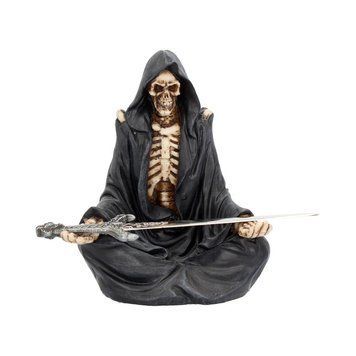
In Islamic tradition, Azrael gently separates the soul from the body and guides it onward, while an angel with a lantern lights the path for the departed. Figures of Azrael measuring 26.5 cm, the Angel of Death with a Lantern measuring 34.5 cm, and Death with a Sword measuring 15 cm suit personal reflections on transformation. The Death arcana speaks of a change of form: what came before leaves so that the next thing can find room to be born.
Why keep a figure of Death at home
Every home has pages that need to be read to the end so that the next story does not begin over the old one. A figure of Death helps preserve the memory of ancestors, complete outworn cycles, and meet change more calmly. On an altar, it marks the recognition of an ending, without which something new finds it hard to gain support. It preserves memory in the home together with an honest relationship to time.
Family memory gathers around simple things, as fire gathers around its hearth. An ancestor altar is usually made up of a figure, photographs, a candle, water, and bread. At Samhain in late October, the Day of the Dead on 1-2 November, or the Slavic Dziady, people approach it with the names of the departed and family stories. You can place skulls nearby as a sign of memory and continuity if this symbol is close to your tradition.
Sometimes an ending asks for a clear line, as a letter asks for its final sentence. After a relationship, job, or long stage of life, the figure helps mark this boundary and leave the past in its place. It is not associated with misfortune: remembering death restores the value of the present day and teaches greater care with time. Let the figure stand in a clean, respectful place where you can calmly reflect on its meaning.
How to choose a god of death figurine
The choice begins with the intention you are ready to give a place on your altar. First, listen to the tradition and your own request, then match the size and material to the shelf or altar. When the image is clear to you in advance, the figure becomes part of your work rather than remaining random decor.
Before placing an order, it is useful to check several things:
- Tradition. Santa Muerte and Mictlantecuhtli belong to the Mexican line, Mara to the Slavic one, Azrael to the angelic tradition, and the Reaper to European allegory. Let the images on the altar speak a language that is clear to one another, so their meaning does not fall apart.
- Intention. Protection, memory of ancestors, completing a cycle, and working with time unfold through different symbols and attributes. A scythe, lantern, or hourglass is fitting when you understand which thought you want to keep close.
- Material. Wood retains a warm, living texture, as seen in the 18.5 cm Santa Muerte and the alder Mara. Bronze-effect polystone suits weighty, detailed figures, standard polystone suits more restrained forms, and handmade resin suits original images. Keep the figurine's place in mind because the material affects both how it feels in the hand and how it fits into the interior.
- Size. The three figures in the set measure 9.5 cm in height, 15-21 cm is usually enough for a shelf, and 26-38 cm suits a central altar figure. Measure the chosen space in advance so that the 38 cm "Death with a Bell" or the 26 cm "Kiss of Death" does not take up the entire shelf.
The approximate price of god of death figurines ranges from 995-5350 UAH. When the place and meaning are already clear, the right form is found more calmly.
How we help you choose a figure for an ancestor altar
You can contact the shop by phone, messenger, or e-mail and receive advice from practitioners. The showroom in Kyiv at Metrograd Shopping Centre, Bessarabska Square, with an entrance from Khreshchatyk Street, provides an additional opportunity to see a figure up close and hold it before purchase.
These terms are also important when ordering:
- You are advised by practitioners who work with the tools presented in the shop.
- A loyalty discount programme is available for regular customers.
- Orders are shipped on the day they are placed when the conditions are met.
- Nova Poshta and Ukrposhta deliver within Ukraine and abroad, while courier delivery in Kyiv and self-collection are also available.
- Orders can be paid for by online card, bank transfer, or cash on delivery with a prepayment.
Buy a god of death figurine when its tradition and symbols are clear to you. Prices range from 995-5350 UAH. If you have doubts about an image, message us before ordering to choose an altar figure calmly and without leaving it to chance.
Frequently asked questions about gods of death
How is Santa Muerte different from Mictlantecuhtli?
Mictlantecuhtli is the Aztec ruler of the dead whose image became one of the foundations of Santa Muerte. Santa Muerte developed within Mexican folk veneration, so modern figurines sometimes contain features of both.
Why is Azrael called an angel rather than a demon?
Because Azrael is an angel who guides souls onward and guards the transition. His image is connected with care for the path of the departed, so he is not associated with harm.
Can Santa Muerte be placed beside other deities?
Yes. Let such an arrangement be clear to you and respectful of the traditions of each image. It is best to give Santa Muerte a separate place, removing random objects and leaving nearby only what relates to your request or the memory of ancestors.
Can a Death figurine be given as a gift?
Yes. Such a gift is appropriate for someone who already works with this image or has directly expressed a wish for one. Give the figurine with an understanding of its tradition so that it does not become a joke or a frightening sign.
How quickly do you ship an order?
On the day it is placed, provided the conditions are met. The delivery method and the possibility of cash on delivery with a prepayment are confirmed when ordering.