





|
Quantity
|
Total
|
||
|
|
|||
|
|
|||
Hindu God Statues
Hindu god statues are figures of Ganesha, Shiva, Lakshmi, and other Hindu deities that find a place in the home for worship, meditation, and as a sign of wellbeing. Such an image is called a murti. It is welcomed as a guest, with light, water, and flowers placed nearby so that reverence takes on a simple, earthly form.
A murti is not an abstract symbol left somewhere in a book. When you choose a figure, you give your home the presence of the force you wish to turn to in everyday matters: prosperity, clarity, protection, or inner support. The world responds to clear intention, so keep close the image whose support you need now.
How Hinduism understands the image of a god
When the eyes have something to rest upon, prayer gathers like water in a bowl. For a Hindu, a murti becomes a form through which a deity receives love, attention, and offerings; during puja, it helps hold the mind and intention steady. Give the figure a clean, worthy place and treat it as an honored guest.
Behind different faces flows one divine reality, like a single river finding several channels. The Trimurti describes its three actions: Brahma creates, Vishnu preserves creation, and Shiva clears the way of what has outlived its time. This is how the seasons change, and how the earth prepares to receive a new seed after decay.
In Hinduism, feminine power is called shakti and appears in many forms. Durga offers protection, Kali helps release fear, Lakshmi is linked with prosperity, and Saraswati with knowledge and art. Let the statue speak to the part of your life that needs support now.
Many hands and heads remind us that great work is rarely done by a single force. A deity may hold gifts, weapons, gestures of blessing, and signs of power over particular energies. Such an image keeps one simple truth in mind: a task may require wisdom, patience, and resolve together.
Why Ganesha is worshipped first
Before any new path, the threshold can seem higher than it truly is. Ganesha, the elephant-headed god, removes obstacles, so people turn to him before work, travel, study, marriage, or an important conversation. When the whole path is still hidden around the bend, place his figure where you can see it and ask for clarity for the next right step.
In an old legend, change comes suddenly, like a door thrown open by a strong wind. Ganesha is considered the son of Shiva and Parvati: Shiva did not recognize the boy guarding his mother's chambers and, in anger, cut off his head, then restored him to life with the head of the first animal he encountered, an elephant. This story speaks of the hard truth of change: the end of what was can bring a person new strength and new vision.
Ganesha's appearance is made up of signs that remain nearby like quiet reminders in the home. His large head is associated with wisdom, his large ears speak of the ability to listen, and his broken tusk refers to the legend of writing the Mahabharata. The mouse, his vahana, represents the restless mind that can be given direction, while modak sweets recall the joy of the fruits of labor.
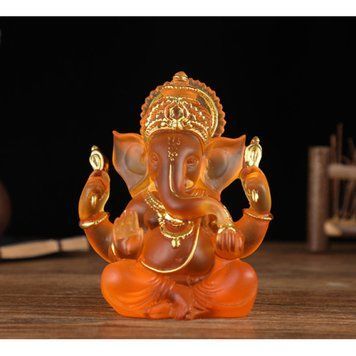
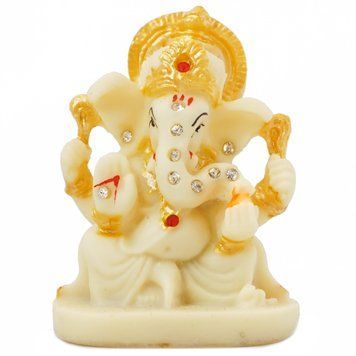
A new undertaking asks for a blessing, as a letter asks for a clear signature. People turn to Ganesha before beginnings, and he is honored with particular ceremony during Ganesh Chaturthi. For a brief home devotion, the mantra "Om Ganeshaya Namaha" is suitable when spoken with attention. A 24 cm Ganesha can find a place on an altar or anywhere he will be seen daily, while a brass Sleeping Ganesha around 3 cm high can rest quietly on a desk.
What Hindu gods hold in their hands
The objects in a deity's hands and its vahana can be read as signs on a familiar road. They show which force a murti is connected with and what quality you invoke in prayer or meditation.
|
God |
Attributes |
Sphere |
|
Shiva |
Trident, crescent moon, snake, third eye |
Transformation, meditation, asceticism |
|
Lakshmi |
Lotus, coins |
Prosperity, wellbeing, beauty |
|
Saraswati |
Veena, book, swan |
Knowledge, art, speech |
|
Durga |
Lion, weapons in many hands |
Protection, victory over evil |
|
Ganga |
Water vessel, makara |
Purification |
Shiva's trident brings the will into one clear line, while the third eye speaks of a gaze deeper than the familiar stream of thoughts. The lotus in Lakshmi's hands carries the image of prosperity that grows from pure intention amid everyday bustle. Saraswati's veena sounds only in tuned hands, so knowledge needs attention and steady work.
When several murtis stand together, they need a clean, respectful place free from random objects. During Diwali, Ganesha, Lakshmi, and Saraswati are often placed together, bringing together an auspicious beginning, prosperity, and wisdom. Lay a shared clean cloth for them or place them on a tray so each figure retains its own place.
Why fierce goddesses protect
Protection can wear the face of flame that burns away fear, evil, and illusion, leaving a person something to rely on. Durga and Kali embody the fierce aspect of the divine mother; people turn to their images when they need to stop what is destructive, regain dignity, and move through change. The intention here should be clear, like a hand closing a door on what no longer has a place.
Riding a lion, Durga confronts the buffalo demon Mahishasura, and this image preserves the memory of victory over a force that has gone out of control. The weapons in her many hands speak of readiness to meet danger from different sides. The nine nights of Navaratri are dedicated to Durga and her manifestations, while a statue of the goddess on a lion can support courage in everyday decisions.
Kali is called the dark goddess of time because time can cut away what a person holds onto out of fear. Her black skin, necklace of heads, and protruding tongue point to the destruction of ego, false attachments, and fear of mortality. In tantra, Kali remains a mother who frees a person from a bond that has already become painful.
Durga receives requests for protection and strength in struggle, while Kali is invoked when the time has come to end a long-standing state of being held back. Durga on a lion at 27 cm can become a central image, a brass miniature around 3.5 cm fits into a small space, and a 23 cm wooden Kali is best given a calm separate place. Let your devotion to these goddesses be respectful and precise, without interest in their frightening appearance alone.
How to perform puja at home
Puja receives a murti as an honored guest, offering it flame, fragrance, water, flowers, and food. At home, it does not need to be complex if you keep the place clean and give the ritual calm attention. A small flame before the image gathers the home for a few minutes, so a lamp or candle is lit before beginning.
For a simple puja, follow these steps one by one:
- Wash your hands and tidy the space around the murti so you can pray without hurry.
- Place the figure on a clean cloth, stand, or shelf above the floor.
- Light a lamp or candle before the image.
- Light incense sticks if their fragrance is appropriate in your home.
- Set out clean water and offer flowers or a small garland.
- Leave a sweet or fruit as an offering.
- Recite a mantra, such as an invocation to Ganesha, or say a few words from the heart.
- Bow, give thanks, and then eat the offering yourself as prasad.
Meat and alcohol are not left near a murti, and the figure itself is not placed on the floor or near shoes. A clean shelf and a small cloth beneath the figure are enough if there is not yet room for a full altar. Home puja rests on respect and attention, not on the ability to reproduce a complex ritual.
Where to place a Hindu god statue
An image in the home should have its own quiet place, like a flame in a lamp. A murti is placed above floor level on a clean surface, and vastu recommends the northeast part of the home for this. There is no need to rearrange your home or worry over every detail: find a corner you can look toward consciously and without haste. Among papers, cups, and random objects, the figure dissolves into daily life and attention to it quickly scatters.
The character of the deity suggests where its presence will be appropriate:
- Ganesha welcomes undertakings at their very beginning. Place him near the entrance or on a desk where plans, decisions, and new activities take shape.
- Lakshmi keeps order in what gives the home support. A place where money is kept suits her, near light and without unnecessary objects.
- Saraswati carries knowledge into daily work. Her figure works well on a desk for study, writing, reading, or music.
- Shiva is close to the quiet in which thought becomes clearer. Give him a corner for meditation, yoga, or peaceful rest.
- Brass miniatures are easy to take on a journey. On a desk, in a car, or on a travel altar, they need a stable, clean stand.
The floor, bathroom, and an area near shoes are unsuitable for a murti. If the figure needs to be put away for a time, wrap it in a clean cloth and place it on a shelf or in a separate box. The world responds to a clear attitude toward what you welcome into your home, and here it is formed through simple daily actions.
How to choose a Hindu god statue
A deity figure enters the home as an image you are ready to give attention to, rather than as decoration for an empty shelf. First, clarify which force you wish to address, then choose a material, size, and price range that suit your space and practice.
- Each deity has its own language of devotion. Ganesha is chosen for beginnings, Lakshmi for prosperity, Saraswati for knowledge, Shiva for inner work, and Durga and Kali for protection and decisive change. Let the image answer a living question in your life, and the figure will naturally become part of your practice.
- Material gives the figure its weight, texture, and care needs, just as a setting changes the feeling of a stone. Brass is suitable for weighty, durable miniatures, including Sleeping Ganesha and Durga on a lion at around 3-3.5 cm. Marble chips are used for Shiva at 14 cm, Lakshmi at 10 cm, and Saraswati at 18 cm; wood for Kali at 23 cm; and bronze-effect polystone for Ganesha at 24 cm, Ganga at 20 cm, and Durga at 27 cm. Choose a material that feels right to you in weight, care, and the atmosphere of your space.
- The size of a murti should have its place before you order. A miniature is convenient on a desk and while travelling, figures 10-18 cm high sit well on a home altar, and 20-27 cm pieces become a central image. Measure the shelf in advance so the murti is neither too large nor lost among other objects.
- Your budget helps intention take a clear form. The price range is approximately 450-5850 UAH. Let the murti you choose have a worthy place in your home.
How we help you choose a murti
When a deity image is looking for its place, questions about size, details, and placement are best clarified in advance. We answer questions about the assortment, and in Kyiv you can visit our showroom at Bessarabska Square 2, Metrograd Shopping Centre, entrance from Khreshchatyk, to see the figures in person.
- Consultations are provided by practitioners who work with the tools from our store themselves.
- A cumulative discount programme is available for regular customers.
- We ship orders on the day they are placed when shipping conditions are met.
- Nova Poshta and Ukrposhta deliver across Ukraine and abroad, while courier delivery in Kyiv and self-collection are also available.
- Orders can be paid for by card on the website, by bank transfer, cash on delivery with prepayment, or cash in the store.
It is worth buying a Hindu god statue when you already know where it will stand and what place it will hold in your practice. Available figures cost approximately 450-5850 UAH. If you want to confirm the size, deity image, or placement method, message us before ordering. The catalogue also includes prayer beads and items from the Buddhism section.
Frequently asked questions about Hindu gods
Can you keep a Ganesha figure if you are not Hindu?
Yes. A murti carries the memory of a living religious tradition, so it calls for a respectful attitude. Give Ganesha a clean place and address him in your own words.
Can a Ganesha figure be given as a gift?
Yes. Ganesha is often given to someone starting a business, moving home, studying, or entering an important stage of life. Present the figure with wishes for wisdom, good fortune, and an open road for new beginnings.
Can several gods be placed on one altar?
Yes. A home altar can bring together several deities if each image has enough space and attention. Leave room between the figures and keep the shared corner clean.
What should you do if a god statue breaks?
Traditionally, a broken murti is released with gratitude into water or committed to the earth. Before doing so, light a lamp, thank the image for its time in the home, and wrap the pieces in a clean cloth.
Can I order a figure with international delivery?
Yes. Figures are shipped abroad through Nova Poshta and Ukrposhta. Before placing your order, ask in the chat about delivery to your country and a suitable payment method.