







|
Quantity
|
Total
|
||
|
|
|||
|
|
|||
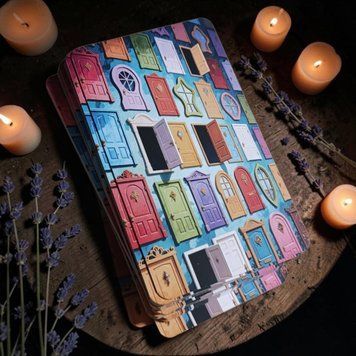
If you've already come across decks for self-discovery that don't have a single correct meaning per card, you already understand the logic of this page. Metaphoric cards aren't tied to a number, a suit, or a meaning shared by everyone: the meaning is born the moment a specific person with a specific question looks at the image. Tarot and Lenormand work differently — there, the spread follows a system of meanings built up over centuries.
The abbreviation stands for metaphoric associative cards — a fuller version of the shorter 'metaphoric cards' used more often in conversation. The format grew out of the therapeutic OH deck: in 1975 it was created by the artist Ely Raman, who combined abstract, caption-free images with the idea that the viewer decides for themselves what they're looking at. There's no correct or incorrect reading here — only the reading that happens for a specific person at a specific moment.
The Meaning That Isn't in the Booklet
A deck usually comes with a booklet offering a few prompts, but it's important to understand what happens without it. The meaning read from an image isn't printed on the back of the card and doesn't depend on what's in the publisher's booklet. It forms in the mind of whoever is holding the card right now — out of their personal history, their current question, and whatever caught their eye.
Take a card showing a person standing on a shore, looking at the water. For someone asking about a job change, this image reads as a pause before a decision — standing still until clarity arrives. For someone else who came with a question about a relationship, the same card lands differently. The water reads as something you can't hold in your hands, the shore as a safe distance from which it's easier to notice something. The picture doesn't change. What changes is what the viewer brings to it.
This is usually where the main doubt comes up: what if I don't see anything, or see it wrong. Don't worry — there's no correct reading by definition, and it's impossible to see 'too little' or 'the wrong thing' in an image. The card's job is to give you a hook that makes it easier to put into words what was already on your mind.
In that sense, associative cards require no preparation — only a willingness to look calmly at the image and not rush to a conclusion.
How People Work with Metaphoric Cards
In personal practice, metaphoric cards are most often used for reflection — no therapist, no session, just on your own. It's enough to pull one card in the morning and ask yourself what deserves attention today, or lay out a few cards before an important conversation to notice something that would otherwise go unspoken.
A separate, fully independent layer of use is the work of psychologists and coaches. Metaphoric cards for a psychologist are a working tool within a session. The deck helps a client put into words something hard to state directly, especially at the start of a meeting, when the answer to a direct question like 'what's bothering you' hasn't taken shape yet. Coaches use the same principle in other formats — for example, in group sessions, where a card starts a conversation within the team rather than individual reflection.
In practice, both the personal and professional layers rely on the same handful of techniques for working with the deck. Here are the three most common ones.
-
One card for one question — the simplest way in. The card is drawn for a question formulated in advance, and time is given to study the image without rushing to a conclusion.
-
A multi-card spread — for a broader question, when a single image isn't enough. Three or four cards are laid out in a row and read as a sequence: what happened, what's happening now, where it's heading.
-
Paired work — a spread for two, whether it's a psychologist's consultation with a client or a conversation between partners. Each person draws their own card for the same question, then both describe what they saw — showing not just each individual answer but the difference in perspective.
None of these three techniques requires special preparation — only the attention and time the reader is willing to give to the image in front of them.
The Staff at Artifacts of the Vedun Know These Decks Firsthand
The metaphoric-card decks at Artifacts of the Vedun aren't a single assortment under one label. Each deck has its own illustration style, its own print run, and its own author, and the store's staff have personally worked with most of them, not just seen photos on the publisher's site. That's a difference you notice in practice. One deck suits a gentle conversation with a child, another is harsher in its imagery and works better for an adult question about a crisis. That kind of comparison comes from firsthand experience, not a ready-made description on a website. That's why it's worth asking a consultant before buying instead of going by price alone.
-
Loyalty program: a cumulative discount of 1 to 10%, promo codes by newsletter, a discount on the store's birthday.
-
Only original editions of metaphoric-card decks, no replicas or counterfeits.
-
Orders processed and shipped the same day.
-
A consultation with a staff member who has personally laid out this specific deck, not just repeated the publisher's description.
-
A physical showroom in Kyiv — you can flip through several decks in person and compare illustration styles before ordering.
The metaphoric-card catalog at Artifacts of the Vedun holds more than a dozen decks, and staff have already worked personally with most of them. Each has its own price, listed on that deck's page, ranging from affordable basic sets to limited-edition author decks. Orders are placed right on the site, then assembled and shipped the same day. If you're torn between two or three options, write to us in advance — we'll compare the decks by how they read in person, not just by the photo on the site.
Questions About Metaphoric Cards
Below are the questions most often asked in messages and in the showroom before buying metaphoric cards — including how to choose a first deck, what to do with doubt at the start of the practice, and what happens if a deck ultimately doesn't suit you.
Do you need special abilities to read metaphoric cards?
No — and that's the most common misconception about the format. The ability to read an image has nothing to do with psychic powers or special training: it's built on paying attention to your own associations and being willing not to dismiss the first thing that comes to mind. The skill develops over a few sessions rather than requiring any special gift from the start.
How do metaphoric cards differ from Tarot, Lenormand, and oracle cards?
Tarot, Lenormand, and most oracle decks have a fixed system of meanings: a specific card means roughly the same thing regardless of who drew it. Metaphoric cards have no such system at all — the meaning is born anew each time, out of the viewer's personal association, not a reference book of meanings.
How many cards should you draw in one session?
One card is usually enough for a short question. Three or four cards laid out in a row suit a broader theme: what happened, what's happening now, where it's heading. More than five cards at once makes reading harder — the images start to overlap, and instead of clarity you get noise.
Can metaphoric cards be used with someone else — as a couple, or with a child?
Yes, paired work is one of the most popular formats. Each person draws their own card for the same question, then both describe what they saw — showing not just each individual answer but the difference in perspective. With children the format works more gently: the child usually chooses the card themselves, and the adult just asks a guiding question without commenting on the choice.
Can you return or exchange a deck if it doesn't suit you?
Metaphoric cards are printed products. Under the law, these goods aren't subject to return within fourteen days — exchange is only possible in case of a factory defect or other flaw. You can check the deck right when you receive your order.