








|
Quantity
|
Total
|
||
|
|
|||
|
|
|||
Altar Cloths for Rituals and Card Readings
An altar cloth separates a table used for readings or an altar from everyday activities. Just as a circle of light from a lamp gathers your gaze in one place, the fabric keeps your question, cards, and chosen tools before you. The deck does not slide around or touch crumbs and marks left on the table, so many Tarot readers keep a dedicated cloth for spreads. Let it become a clear boundary where your intention takes shape and remains at the centre of your attention.
Why you need an altar cloth in your practice
A cloth keeps your work within its boundaries, much as a frame holds a drawing together. Everything you place on it belongs to the spread or ritual, while an ordinary table becomes a place for intention. Lay out the cloth before you begin so your attention does not drift toward household concerns.
The fabric takes on everyday traces like a quiet shore receiving what the water brings. Cards, stones, and candles gain a layer between them and the hard tabletop: dust is less noticeable, while deck corners and stone surfaces touch the hard base less often. Place candles in a holder or on a stable stand so wax does not soak into the fibres.
A familiar movement creates a well-known path to concentration. When you take out and spread your cloth, your body remembers the transition from ordinary concerns to practice. Over time, it becomes easier to focus even after a noisy day: your hands already know the gesture that brings you back to your work.
Why cards are laid out on fabric
A deck needs its own place, just as a letter needs an envelope before its journey. We care for cards as working tools and do not mix them with everyday items on the table. This is why decks are often stored in a scarf or piece of fabric, and the cloth is unfolded before a reading: the work begins with a clear gesture.
There is also a simple reason that your hands can feel. Velvet, velour, and dense fabric keep cards level, making it easy to slide, gather, and turn over the Arcana. On a smooth tabletop, a wide spread can shift apart as if a breeze had touched sheets of paper.
One cloth can serve both a card spread and altar work. It gives you a convenient place beside the deck for a candle or stone if your practice calls for one. Many people keep a separate cloth for cards so every meeting with them retains a clear rhythm that the world responds to. When choosing a new deck, browse Tarot cards and consider the space needed for your usual spread in advance.
What the colour of an altar cloth means
Colour on an altar gives thought a direction, like a candle flame holding your gaze in darkness. It helps you stay within the chosen sphere of work and keeps your attention from scattering among different intentions. Your will remains your own, while the fabric's shade supports what you have chosen to make space for today.
|
Colour |
Sphere |
Suitable rituals |
|
Black |
Protection, hidden knowledge, deep work |
Protective practices, shadow work |
|
Purple |
Intuition, mysticism, connection with higher powers |
Meditation, spiritual work, transformation |
|
Red and burgundy |
Strength, passion, determination |
Love rituals, strengthening the will |
|
Green |
Growth, abundance, restoration |
Money practices, health, harmony |
|
Blue and light blue |
Calm, depth, focus |
Meditation, dream and intuition work |
|
Yellow and lemon |
Joy, solar energy, clarity of thought |
Practices for luck, inspiration, learning |
|
Beige |
Earth, stability, connection with nature |
Grounding, a home altar, nature work |
|
Gold and silver |
Solar and lunar power, intuition |
Festive rituals, lunar practice |
A plain cloth changes the voice of the altar without rearranging familiar items. If you keep several cloths in different colours, the overall order stays the same while each new task has a fitting background. Green supports an intention for growth, while blue preserves the quiet needed around a spread.
A pattern gives the fabric a second voice, so pair its colour and symbol with what you are sitting down to address at the altar. The gold-toned "Night Sky" holds starry depth, while a green cloth with silver trim combines abundance with lunar intuition. Let the colour before you answer the question you hold today.
Which symbols appear on altar cloths
A symbol on an altar cloth remains on the altar like a seal on a letter: each time, it reminds you what force you are working with and why you have gathered. Let the image resonate with the language of your practice, and the cloth will support your work rather than simply decorate the table.
When cards lie nearby, candles are burning, and other tools are present, a pattern helps your thoughts stay gathered. One sign may remain with you for years, while another may accompany a particular period or lunar cycle. The following images can be found:
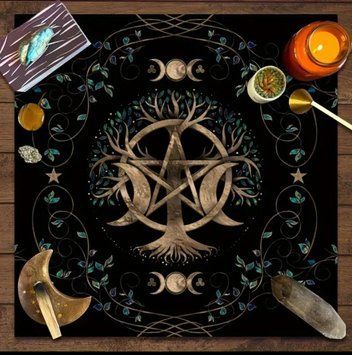
- The pentagram gathers the five elements into a protective circle. It is placed on an altar for protection rituals, consecrating a space, and general witchcraft practice.
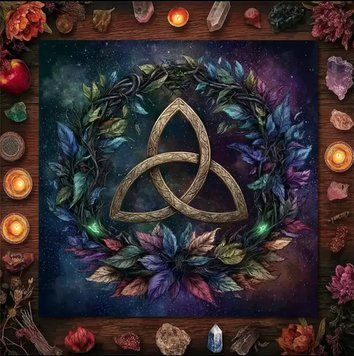
- The triquetra and Celtic knots follow the line of trinity, connection, and continuity. These motifs suit practices concerning family, relationships, ancestral memory, and natural cycles.
- The Tree of Life represents lineage, growth, and different levels of the world. This sign supports work with development, finding stability, and understanding your path.
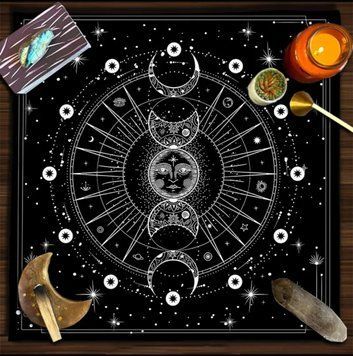
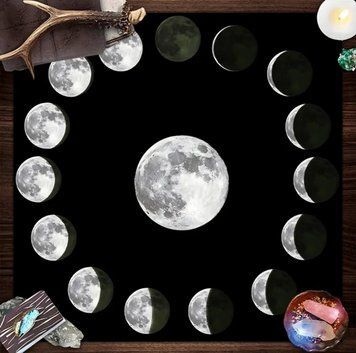
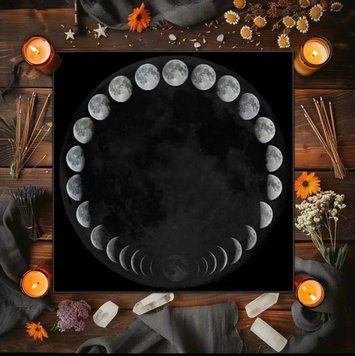
- Moon phases and the Triple Moon remind us that every undertaking has its own cycle and time. They suit those who structure their practice around the lunar calendar.
- Hecate with dogs stands at a crossroads where the path divides in two. This image fits witchcraft practice when you need to see a turning point and make a decision.
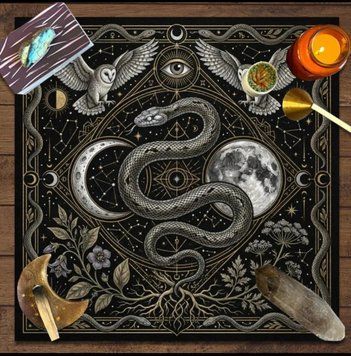
- The Eye of Providence keeps attention on what is still hidden. It is used for readings that clarify a situation and observe concealed circumstances.
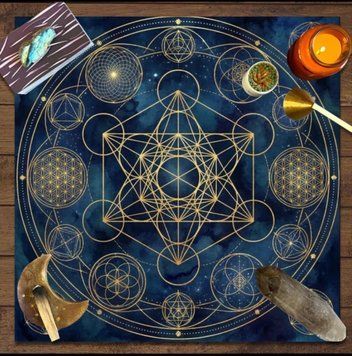
- Metatron's Cube reveals sacred geometry and harmony of form. It suits meditation, creating inner balance, and work with space.
- The Ankh and Eye of Horus carry Egyptian tradition, life, and protection. These symbols are chosen for an altar dedicated to this system of imagery.
- The Goat of Mendes draws attention to occult tradition and shadow work. It suits those who consciously explore repressed aspects of themselves.
Every appeal has its own language, and an image on fabric helps speak it clearly. "Pentagram and Tree of Life", "Triquetra with Leaves", "Hecate with Dogs", "Eye of Providence", "Metatron's Cube", and "Ankh" lead toward different powers, while the cloth always gathers a space for the work.
How to change an altar cloth for different tasks and seasons
An altar has its own calendar: a new task, moon phase, or Wheel of the Year festival calls for a different mood. Lay down a new cloth, and the familiar table immediately gathers around the current work, marking the change of season without unnecessary rearranging.
The colour of the fabric gives your work a clear sign. Keep a green cloth for money rituals, growth, and restoration, a red one for love and strengthening determination, and a black one for protection and deep work. Plain velvet cloths measuring 50×50 cm are convenient to keep as a set: blue, red, green, purple, or beige. Then a new task only requires unfolding the right fabric.
The lunar cycle follows its own course, and a cloth helps maintain its direction. A dark or silver fabric suits the waning and new moon, when work turns inward and moves toward completion. A light cloth is laid out for the waxing and full moon, when intention is directed outward. Let this order be a support that you compare with your own observations.
The Wheel of the Year turns through its festivals, and contemporary Wiccan practice marks this by changing colours on the altar. A black cloth is often laid out for Samhain, while green and red suit Beltane. This gives the festival a visible form, while the changing season remains noticeable in the work itself.
How to choose an altar cloth
An altar cloth should fit both the size of your table and the nature of your work: card spreads, candles, or a permanent altar. When your hands have enough room, your attention stays on the cards and objects, so measure the table and remember your widest spread before buying.
Let the cloth become part of your work rather than remain folded in a cupboard. Consider several details:
- Size. A small altar or a three-to-five-card spread usually needs only 45-50 cm. A table with a large spread, candles, and a chalice is better suited to 70-80 cm, so objects do not end up at the very edge.
- Fabric. Velvet and velour provide soft support for cards and reduce slipping, though their pile collects dust and drops of wax. Polyester is easier to wash, and its pattern stays crisp, making it convenient for regular readings.
- Plain background or symbol. A plain cloth lets you create the altar's mood through colour, while a pattern holds the chosen theme. Let the fabric support your familiar way of working without competing with it.
- Colour for the sphere of work. Green supports growth, purple supports intuition, red supports determination, and beige supports a connection with the earth. A random shade will not spoil a ritual, though it conveys the clarity of intention less strongly.
- Edge trim. Braid gives the altar a ceremonial feel and brings objects together into one composition. It is especially visible on a small table, so it is useful to imagine the cloth beside your tools in advance.
Plain velvet altar cloths in blue, red, green, purple, and beige measure 50×50 cm. A spacious altar suits the grey velvet "Pentagram" with silver trim measuring 72×72 cm, the gold-toned "Night Sky", or the velour "Mercury" measuring 80×80 cm. Prices for altar cloths are approximately 300-1360 UAH.
A permanent workspace is best arranged with its base in mind. On altar tables and cabinets, a larger cloth lies more freely, while a 50×50 cm square is often enough for a small home corner. Items to complete the arrangement can be found in the everything for the altar section.
How to wash and store an altar cloth
A crease in fabric remains like the mark of a folded card and can eventually make it harder to lay out a deck evenly. To preserve the cloth's colour, pattern, and smooth surface, wash it gently and store it rolled up. This care is needed for the material and is not a required part of any ritual.
Cool water and hand washing are gentle on most fabrics. A delicate washing-machine cycle is also suitable, while bleach is best avoided so the pattern and colour do not fade. After washing velvet, blot it with a towel, smooth it out, and let it dry without wringing.
An iron can restore a calm, even surface when used according to the fabric. Iron polyester through a thin cloth at a moderate temperature. Treat velvet and velour from the reverse side or steam them so the pile remains lively and full. If a pattern lies unevenly after storage, steam it first and leave the iron for the next step.
Rolling protects the cloth from sharp creases, just as a case protects a delicate item while travelling. Store the cloth rolled up or place it in a separate bag so dust from everyday linen does not settle on it. Before a reading, it will be easy to take out, unfold, and return after the work is done.
Choose a cloth with guidance from a practitioner
Speaking with someone who knows the work from within helps you see the fabric in its future place: on an altar, table, or in a familiar spread. Tell us how your space is arranged, and we will advise you on the range. In Kyiv, you can visit the showroom at Bessarabska Square 2, Metrohrad Shopping Centre, entrance from Khreshchatyk, touch the velvet, and compare sizes in person.
- Cloths are explained by practitioners who work with these tools themselves.
- Regular customers have access to a loyalty discount programme.
- Subject to the conditions, an order may be dispatched on the day it is placed.
- Orders across Ukraine and abroad are delivered by Nova Poshta and Ukrposhta; courier delivery in Kyiv and its suburbs, as well as in-store collection, are also available.
- Orders can be paid for online by card, by bank details, or by cash on delivery with a prepayment.
Once the table size and purpose of the fabric are clear, the cloth easily takes its place in your work. Prices are approximately within the range of 300-1360 UAH. If velvet, polyester, and velour feel different to you, write to us before ordering: together, we will find a divination cloth you can work with comfortably for a long time.
Questions asked before choosing an altar cloth
Can I read cards without a cloth?
Yes. A spread can still be read without a cloth, though fabric keeps cards more even and separates the workspace from the table, especially on a smooth surface.
Can one cloth be used both for an altar and card spreads?
Yes. One cloth can be used at an altar and for readings. A separate fabric for cards means you do not need to clear away candles and other objects before working.
How do I remove wax from an altar cloth?
Wait until the wax has fully hardened and remove the larger pieces by hand. Iron any residue through a paper napkin, and treat velvet from the reverse side so the pile is not flattened.
Is a 50×50 cm cloth large enough for a Celtic Cross spread?
No, 50×50 cm will be too small. Ten cards fit on such a cloth with almost no spare room, so a 70-80 cm size is more convenient for a Celtic Cross, leaving space for your hands and clarifying cards.
Do you ship altar cloths abroad?
Yes. We ship altar cloths with Nova Poshta and Ukrposhta. For international orders, the delivery method depends on the country and the carrier's conditions.